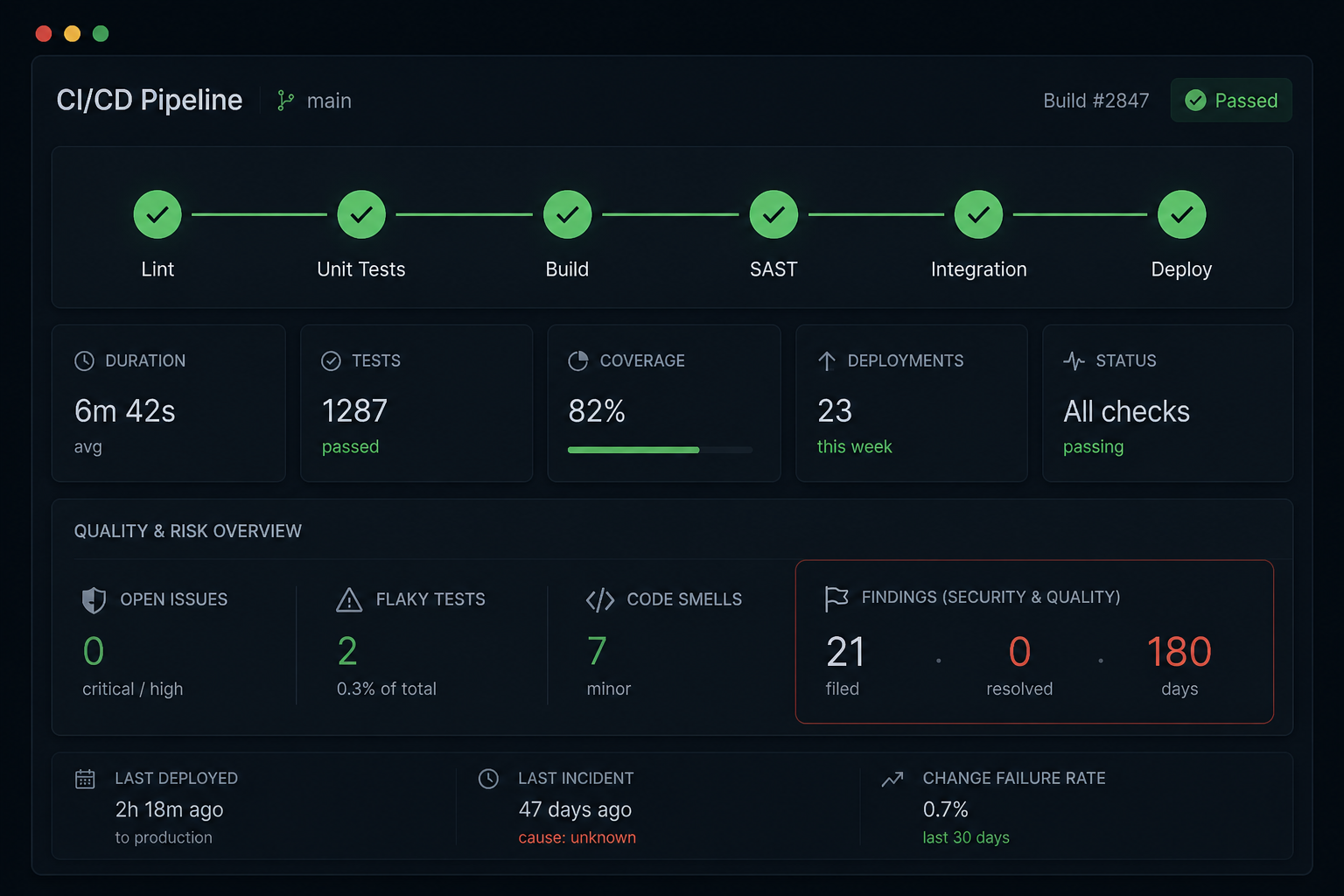
The Pipeline Is Not the Problem
How SDLC policies succeed or fail — and why most of them become compliance theater within 18 months
Morpheus does not offer Neo a better version of the Matrix. He offers him the truth about it.
That distinction matters more than it seems. The Matrix was not broken. It was functional, consistent, and convincing. People lived inside it, went to work inside it, built careers inside it. The problem was not that it failed. The problem was that it was not what it appeared to be.
There is a pattern that repeats itself in software organizations with uncomfortable regularity — and it has the same shape.
A team — usually a good one, usually after a painful incident or an audit — invests serious effort into designing a real SDLC policy. They think carefully about stages. They define quality gates. They integrate security tooling. They document risk classification. They write it all down, get it approved, and roll it out.
Eighteen months later, the policy exists. The pipeline runs. The compliance boxes get checked.
And the engineers have learned exactly which parts to route around, which gates are safe to ignore, and how to make the metrics look healthy without the underlying reality being healthy.
Most organizations take the blue pill at this point — not out of negligence, but because the system looks like it is working. The dashboards are green. The audits pass. Nobody is asking hard questions, because the surface is clean.
If you have ever:
- Approved a PR you did not fully understand
- Reclassified a security finding to unblock a release
- Watched a failing pipeline get bypassed “just this once”
- Sat in a post-incident review where everyone agreed the process had been followed and nobody could explain why the incident happened anyway
You already know this system.
This is not a story about bad engineers. It is a story about a category error — the belief that a well-designed process, once installed, will sustain itself. That the pipeline is the problem, and therefore the pipeline is the solution.
It is not.
The Category Error
When organizations design SDLC policy, they are solving for two different problems simultaneously — and most of the time they do not realize it.
The first problem is technical: what stages should exist, what tools should run at each stage, how severity should be classified, how database changes should be managed, how releases should be governed. This problem is tractable. It has better and worse answers. It responds to careful design.
The second problem is social: whether the people inside the system will treat the policy as a shared contract or as an obstacle to route around. Whether a failing pipeline will be fixed or bypassed. Whether a reviewer will apply genuine judgment or perform a ritual. Whether a risk classification will be honest or optimistic.
The technical problem is where organizations spend most of their design energy. The social problem is what determines whether the policy actually works.
These are not the same problem. A policy that solves the first without addressing the second is not half a solution. It is an expensive way to produce compliance theater.
The easiest way to understand your system is not to read the policy. It is to observe what happens when following the policy conflicts with shipping on time.
This is where most systems quietly fail.
Why Pipelines Fail to Enforce Culture
A CI/CD pipeline is not a neutral technical artifact. It is a representation of what an organization believes matters — and, more importantly, of how much the organization trusts the people building the systems it runs.
When a pipeline is designed primarily as a control mechanism — to catch engineers doing the wrong thing — it produces a specific cultural response. Engineers begin to relate to it adversarially. The pipeline becomes something to satisfy, not something to learn from. When it fails, the question is not “what does this tell us?” but “how do we get this green?” When it slows delivery, the question is not “is this friction worth it?” but “can we skip this?”
This adversarial posture is not irrational. It is the natural response to a system that treats its users as compliance subjects rather than decision-makers.
It would be easy to argue that strong pipelines do enforce behavior — after all, you can block deployments, fail builds, and enforce rules mechanically. But what they enforce is compliance, not intent. And compliance without intent is exactly how systems drift into theater.
The failure mode looks like this in practice:
A security scan flags a high-severity finding on a feature branch. The developer doesn’t understand the finding, cannot fix it quickly, and has a sprint deadline. The PR sits. A senior engineer reviews it, doesn’t understand the finding either, approves it anyway, and makes a mental note to address it later. The note is never revisited. The finding gets promoted through the pipeline. At release time it is flagged again, reclassified as a known risk, and documented. The documentation goes into a folder that nobody reads.
The policy worked exactly as written. Every gate fired. Every log entry was made. The finding traveled from development to production with full auditability and zero meaningful intervention.
This is compliance theater. It is not a failure of the policy’s technical design. It is a failure of the social contract the policy assumed but never built.
This is the red pill moment most engineering organizations never take. The blue pill is not ignorance — it is the active choice to keep living inside a system that looks like it is working. Morpheus was not describing a broken world. He was describing a comfortable one. The pipelines pass. The dashboards are green. The audit evidence is filed. And somewhere underneath all of it, the system is hollow — quietly, consistently, invisibly hollow — until something breaks in production and nobody can explain why, because the process that was supposed to prevent it had been theater for months.
What Policies Assume Without Saying So
Every SDLC policy contains a set of implicit assumptions about the humans who will operate within it. Most of these assumptions are never written down — because to the people writing the policy, they seem obvious.
They all reduce to one thing: that people will act with integrity under pressure. That reviewers will apply genuine judgment rather than perform a ritual. That developers will write tests that validate behavior rather than satisfy a threshold. That risk will be classified honestly rather than optimistically.
None of these are guaranteed by policy text. All of them depend on things the policy cannot directly control: shared understanding, psychological safety, genuine ownership, and the organizational signals that tell engineers whether honesty is rewarded or penalized.
The most dangerous assumption of all is the one about incentives. A policy tells engineers what they are supposed to do. The incentive structure around them tells them what they are actually rewarded for. When those two things diverge — when the policy says “classify risk honestly” and the culture says “be optimistic so we can ship” — the incentive wins. Every time.
And this is the part no policy document admits.
Forward-Only Is a Culture Decision Dressed as a Technical One
Consider a specific design choice that appears in well-designed SDLC policies: the forward-only principle.
The rule is straightforward. When something breaks, you fix it forward. No reverts. No “we’ll just roll back and figure it out later.” The code goes forward, the database migrations go forward, the releases go forward.
On the surface this looks like a technical constraint. It is not. It is a cultural stance.
Forward-only development assumes that the team will invest in making changes safe before they are made, not after. It assumes that regression tests will be written with genuine intent. It assumes that database migrations will be designed to be incrementally safe, not just functionally correct. It assumes that engineers will declare architectural impact honestly before it is reviewed, not retroactively justify it afterward.
Without those assumptions being socially true, the forward-only rule produces a different outcome: teams that cannot revert accumulate forward-fixes that are poorly understood, stacked on top of each other, each one carrying the technical debt of the emergency it was meant to resolve. The principle that was designed to enforce discipline becomes the mechanism by which undisciplined decisions are permanently baked into the system.
The same pattern holds for every structurally significant policy decision. Mandatory impact analysis is only as good as the honesty of the engineers declaring it. Severity classification is only as good as the judgment of the engineers applying it. Architectural validation is only as good as the understanding of the engineers reviewing it.
Policy gives these decisions a structure. Culture gives them a substance. Without both, you have a form without a function.
The Social Contract of a Quality Gate
A quality gate works when the people on both sides of it share an understanding of what it is for.
On one side is the developer who has written code, declared its risk, included tests, and submitted a merge request. On the other side is a reviewer who is being asked to validate that the change is what it claims to be — correctly implemented, honestly classified, adequately tested, safe to integrate.
This is not a mechanical check. It is a judgment call, made by a person who must understand the change well enough to evaluate it fairly. The policy can specify what the reviewer must check. It cannot specify whether the reviewer will develop the understanding necessary to check it meaningfully.
This has an important implication: the quality gate is only as strong as the shared context between the person who wrote the change and the person reviewing it. When that context is thin — because the reviewer is unfamiliar with the affected domain, because the change is large, because the team is under delivery pressure, because the code was generated by an AI tool that neither person fully understands — the gate fires without doing useful work.
The ritual is performed. The substance is absent.
Healthy SDLC cultures invest continuously in the shared context that makes gates meaningful. This means code ownership that is real, not nominal. It means reviewers who are genuinely qualified to review the things they are asked to review. It means teams that are small enough to maintain shared understanding of the systems they own. It means the time to actually do the review, not the expectation that review will happen in the margins around other work.
These are organizational commitments. They cannot be mandated by a pipeline.
DevSecOps and the Alert Processing Trap
Security integration in CI/CD suffers from a specific version of this problem that is worth naming directly.
The technical design of DevSecOps is tractable. Run fast, signal-oriented security checks on feature branches. Run full SAST, SCA, and authenticated DAST at integration. Classify findings by genuine severity. Block only what actually warrants blocking.
The design philosophy behind this is sound: security controls exist to support decisions at each stage of the pipeline, not to generate artifacts that satisfy an auditor. A CRITICAL finding that blocks a pipeline must be critical enough that a reasonable engineer would agree it should block. A MAJOR finding that is logged but not blocking must be tracked with genuine intent to resolve, not filed and forgotten.
The failure mode — and it is extremely common — is that organizations implement the technical structure without implementing the decision discipline it requires. The backlog grows. The findings are triaged. The system records activity. The risk accumulates. The security posture degrades continuously while the compliance posture remains technically intact. Every finding is documented. None of them are fixed.
This is not a tooling problem. The tools are working as designed. It is a culture problem: the organization has optimized for producing security evidence rather than for being secure.
The distinction matters because they produce different behaviors at every decision point. An organization optimizing for evidence asks “does this finding need to block the pipeline?” and answers that question based on whether blocking it will delay the release. An organization optimizing for security asks “does this finding represent real risk?” and answers based on the actual threat. These are different questions, and they produce different answers, and the difference accumulates over time into a materially different security posture.
No CI/CD policy can mandate the second question if the culture is asking the first.
The Metrics Trap
Organizations that instrument their SDLC policies carefully — tracking pipeline pass rates, mean time to resolution, security finding counts, coverage percentages — will eventually discover that their metrics are healthy and their systems are not.
This is not a paradox. It is the predictable outcome of measuring outputs rather than intent.
A pipeline pass rate tells you whether pipelines are passing. It does not tell you whether the tests that pass them are meaningful, whether the findings that don’t block them are being resolved, whether the risk classifications are honest, or whether the architectural gates are being applied with genuine understanding.
A coverage percentage tells you what fraction of the codebase is touched by tests. It does not tell you whether those tests would catch a real regression, whether the edge cases that matter are covered, or whether the tests were written to validate behavior or to satisfy the metric.
A mean time to resolution for security findings tells you how quickly findings are closed. It does not tell you whether they were closed by remediation or by reclassification.
The logs were correct. The decisions were not.
Metrics are not the problem. The problem is treating metrics as a proxy for the thing the metrics are supposed to measure. When a team understands that it will be evaluated by the metric rather than the underlying reality, optimizing for the metric becomes the rational strategy. The measurement becomes the goal. The goal becomes invisible.
This is Goodhart’s Law operating in an SDLC context, and it is one of the most reliable failure modes in engineering governance.
The solution is not to abandon metrics. Removing them doesn’t produce a healthier culture — it produces ambiguity, which usually turns into bias or politics. The solution is to demote metrics from authority to evidence. Use them to understand performance. Use judgment to reward it.
The earliest sign of policy decay is not failure. It is silent reclassification — when teams start quietly downgrading severity to keep flow moving. By the time it is visible, it has been happening for months.
The metrics that reveal this are not the ones most organizations track. Track reopened bugs, not tickets closed. Track incidents caused by “known risks” that were documented and not fixed. Track the time between detection and actual remediation, not closure. Track how many times pipelines are bypassed. These expose reality instead of rewarding appearances.
And recognize that building a system where people genuinely engage with metrics as signals — rather than gaming them as targets — has a cost. It requires slower short-term delivery, more friction in planning, more uncomfortable conversations. If an organization is not willing to pay that cost, it will get compliance theater instead. That is not a failure of tooling or policy design. It is a choice.
What Actually Sustains a Policy
If pipelines cannot enforce culture, and metrics cannot substitute for judgment, and policy text cannot guarantee honesty — what actually determines whether an SDLC policy works over time?
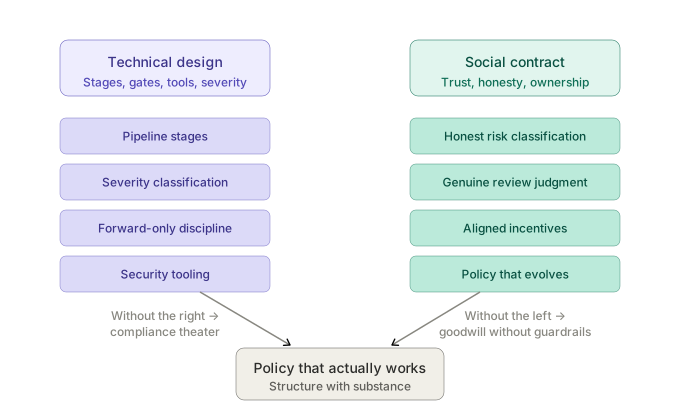
Three things, consistently, in practice.
First: the policy must be legible to the people operating within it. Not legible in the sense that they can read it, but legible in the sense that they understand why each element exists — what risk it addresses, what failure it prevents, what the organization would look like without it. A developer who understands why forward-only development matters will make different decisions than one who sees it as an arbitrary constraint. A reviewer who understands why impact analysis exists will apply it differently than one who sees it as a checkbox. Legibility requires investment in explanation, not just documentation. It requires the organization to treat policy education as an engineering discipline, not an onboarding formality.
Second: the incentive structure must be aligned with the policy, not merely adjacent to it. This means that honest risk classification is rewarded, not penalized. That a developer who raises a genuine concern about a change’s safety is supported, not pressured. That a team that slows down to address a real architectural problem is respected, not seen as blocking delivery. That post-incident reviews result in policy improvements rather than blame allocation. Incentive alignment cannot be mandated. It is expressed through the hundreds of small decisions leaders make about what they visibly value, what they tolerate, and what they hold people accountable for.
Aligning incentives with policy will slow delivery in the short term. Some releases will be delayed. Some concerns will be uncomfortable to raise and more uncomfortable to act on. If an organization is not willing to accept that cost, the incentives will drift back toward throughput — and the policy will become decoration. This is not a cultural failure. It is a predictable system outcome. Once engineers learn that risk can be reclassified to unblock delivery, that behavior is extremely difficult to reverse. Behavior learned under pressure becomes the system’s default. Policy updates don’t erase it. The system does not reset when you update the policy. It remembers what was rewarded.
Third: the policy must evolve. An SDLC policy written at a point in time reflects the organization’s understanding of its risks and constraints at that moment. Six months later the team is different, the product is different, the threat landscape is different, the tooling has changed. A policy that does not update becomes progressively less accurate as a representation of what the organization actually needs — which means it becomes progressively less legitimate in the eyes of the people operating within it. Policies that stop evolving start to be ignored. The mechanism for updating a policy is not a quarterly review meeting. It is the post-incident review that asks “what in our process failed to prevent or catch this?” and the engineering retrospective that asks “what in our pipeline is generating friction without generating value?” It is the ongoing, institutionalized question of whether the policy is actually working — asked by the people who know, which is the engineers running it.
The Policy as a Living System
A well-designed SDLC policy is not a document. It is a system — and like any system, its behavior depends on the interactions between its components, not just on the properties of the components themselves.
The components are the technical elements: the stages, the gates, the tools, the severity classifications, the governance structures. These can be designed carefully, and careful design matters. A policy with sensible staging, honest severity enforcement, forward-only discipline, and layered security integration is genuinely better than one without these things.
But the interactions that determine the system’s actual behavior are social: the trust between developers and reviewers, the honesty with which risk is declared, the seriousness with which findings are addressed, the organizational will to maintain the policy as it ages.
An organization that gets the technical design right but neglects the social interactions will produce a system that looks functional from the outside and is hollow at the center.
An organization that understands the social interactions — that invests in legibility, aligns incentives, creates the conditions for honest judgment, and treats the policy as something that must continuously earn its legitimacy — will find that the technical design becomes self-reinforcing. Engineers will propose improvements because they understand what the policy is for. Reviewers will apply genuine judgment because they feel the weight of the responsibility. Metrics will reflect reality because there is no incentive to make them lie.
The pipeline is not the problem. The pipeline is the expression of an underlying agreement about what quality means, what risk is acceptable, and what it means to take collective ownership of the systems you build.
That agreement is not written in YAML. It is not enforced by a CI runner. It is built, maintained, and continuously renewed by the people inside it — or it quietly ceases to exist while the pipelines keep passing and the findings keep getting filed and the systems keep degrading.
What This Means in Practice
The diagnostic test is simple. When your pipeline fails, what happens next?
Do engineers investigate the root cause — or look for the fastest way to get it green? The answer tells you whether your pipeline is a quality system or a compliance system.
If you are responsible for engineering outcomes, this leads to a small number of non-negotiable decisions:
You must decide whether delivery speed or decision integrity is your real priority. Your system will optimize for whichever one you reward under pressure. Both cannot be equally first.
You must treat pipeline failures as signals, not obstacles. A failing pipeline is the system working. A bypassed pipeline is the system being dismantled, one exception at a time.
You must accept that some releases will be delayed if you want honest risk classification. If every release must go out on time, risk will be hidden, not managed.
You must remove metrics that are being gamed — not just add better ones. Keeping a metric because the dashboard looks good is how systems drift into theater and stay there.
You must invest in shared context, or your quality gates will become rituals. There is no automation substitute for a reviewer who genuinely understands what they are reviewing.
And you must be visible about what you reward. If engineers are recognized for raising real concerns that delay delivery, others will raise them. If they are pressured or penalized, the concerns will stop — but the risks will not.
Culture is not built by what you write down. It is built by what you enforce when it hurts.
A Final Observation
The organizations that have the most sophisticated SDLC policies are not always the ones with the healthiest engineering cultures. Sometimes they are the ones with the most elaborate compliance theater — because the sophistication of the policy became a substitute for the harder work of building the conditions under which it could actually function.
The organizations with the healthiest engineering cultures often have policies that are simpler than you would expect. Not because they have not thought carefully about risk — but because they have thought carefully about what their people can sustain, what their teams can genuinely own, and what their systems can actually enforce. They have calibrated the policy to the culture rather than the culture to the policy.
That calibration is where the real design work happens.
Pipelines don’t fail quietly.
They succeed quietly — while everything underneath them gets worse.
The question is always: what kind of organization is the pipeline designed to serve?
This is part of TECTONICS — a series on how technology organizations actually move. Systems, culture, and scale.
Previous: The Cognitive Load Ceiling: What AI Is Doing to Software Architecture