
The Architecture That Was Supposed to Last
Every generation of software engineers believes it has found the architecture that will not need replacing. Waterfall gave way to layered architectures, which gave way to service-oriented architectures, which gave way to microservices, which are now giving way to modular monoliths. Each transition arrives with genuine conviction that this time, the underlying structure is sound enough to endure. And each time, that conviction eventually erodes — not through technical failure, but through something more fundamental.
The pattern is consistent: a new architecture solves a real and pressing problem. Teams adopt it with enthusiasm. The system grows. The overhead of understanding, navigating, and extending it increases steadily. At some point the architecture stops serving the team and starts burdening it. A reckoning follows — a rewrite, a decomposition, a consolidation — and the search for the next architecture begins.
What is rarely examined in these transitions is the root cause. Organizations do not abandon architectures because they were wrong. They abandon them because the team’s cognitive load ceiling was reached. The architecture outgrew the team’s collective ability to hold it in their heads.
Now a new force has entered this dynamic. Artificial intelligence — in the form of code generation tools, AI-assisted review, autonomous agents, and LLM-based system components — is simultaneously being positioned as the solution to software complexity and quietly introducing a new class of complexity that has no established name. Three questions follow from this that no engineering leader can afford to defer. Does AI actually follow the architectural disciplines the industry spent decades developing? If it does not, do those disciplines still matter? And when AI-assisted codebases eventually become unmaintainable — as they will — is the rewrite still the expensive last resort it once was, or has AI turned it into something more dangerous: a silver bullet that restarts the problem faster than before? An engineering leader might be forgiven for exclaiming “I’m too old for this” — but the more important question is not whether the pace is overwhelming. It is whether the discipline, the judgment, and the accumulated experience that comes with being old enough to know better can be brought to bear on a tool that has none of those things yet.
What Cognitive Load Actually Means in Software
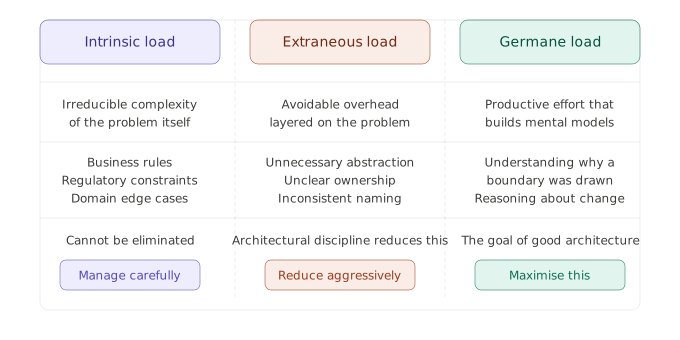
The concept of cognitive load originates in educational psychology. John Sweller introduced Cognitive Load Theory in 1988 to describe the limits of working memory when processing new information [1]. Sweller identified three distinct types. Intrinsic load is the inherent complexity of the subject matter — the irreducible difficulty of the problem being solved. Extraneous load is complexity introduced by poor structure, unnecessary friction, or avoidable confusion — overhead layered on top of the real problem. Germane load is the productive effort directed toward building lasting mental models — the cognitive work that actually leads to understanding rather than just familiarity.
These distinctions translate directly into software engineering. Intrinsic load corresponds to the genuine complexity of the domain: business rules, regulatory constraints, edge cases, and interdependencies that exist regardless of how the system is structured. No architectural choice eliminates this. Extraneous load corresponds to accidental complexity: indirection that adds no value, inconsistent naming conventions, unclear ownership, over-abstraction, and architectural ceremony that generates friction without generating insight. Germane load corresponds to the productive effort engineers invest in building accurate mental models of the system — understanding not just what the code does, but why it is structured the way it is, and what the consequences of changing it might be.
 .
Matthew Skelton and Manuel Pais formalized this connection in Team Topologies (2019), arguing that cognitive load should be treated as a first-class architectural constraint [2]. Their central claim is deceptively simple: teams have a finite cognitive capacity, and system design must actively manage how that capacity is allocated. When a team’s cognitive load exceeds its ceiling, delivery slows, defects increase, and morale deteriorates — not because the engineers are less capable, but because the system has exceeded what any human team can reliably reason about.
This reframes the central question of software architecture entirely. The question is not: which architecture is technically superior? The question is: which architecture best fits within the cognitive constraints of the teams that must build, operate, and extend it, at the scale they currently face?
The answer has always changed as organizations grow. It is now changing again, in ways more disruptive than any previous shift, because of AI.
It is worth noting that this framing is not entirely new. Fred Brooks identified the same underlying constraint in 1975, long before cognitive load theory existed as a formal concept. In The Mythical Man-Month, Brooks argued that conceptual integrity — a unified, coherent vision of what a system is and how it behaves — is the most important consideration in system design [2a]. What he was describing, in the vocabulary available to him, was a system that remains within the cognitive reach of the people responsible for it. Sweller formalized the mechanism in 1988. Skelton and Pais operationalized it in 2019. The constraint itself has been present since the first system outgrew the mind of the person who built it.
Key Insight: Complexity does not disappear when you change architecture. It redistributes. Every architectural decision is ultimately a decision about where cognitive load lives and who carries it.
AI does not remove the cognitive load ceiling. It preserves the constraint, but compresses the timeline on which it is reached.
How Architecture Has Always Responded to the Ceiling
The history of software architecture is, at its core, a history of successive attempts to manage cognitive load — without ever quite naming it that way. Understanding what these attempts achieved, and where each one ultimately failed, is necessary context for understanding what AI is now changing.
The Monolith and Its Limits
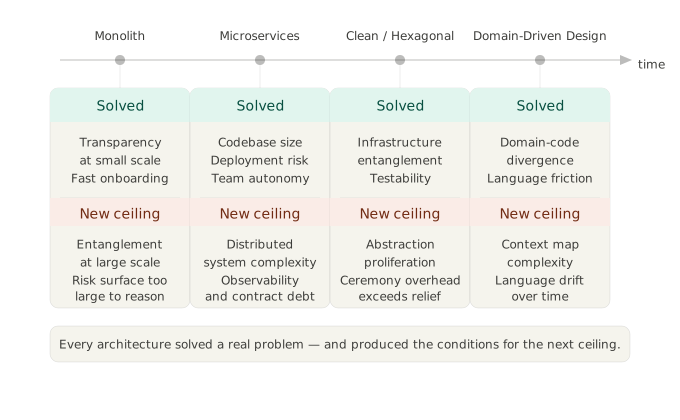
The monolith is the default starting point not because teams lack imagination but because it is cognitively efficient at small scale. A single codebase, a single deployment unit, a shared data model — the entire system is transparent and navigable. Onboarding is fast. Debugging is local. The system fits inside the team’s collective working memory.
The ceiling arrives as the codebase grows and the team expands. The same transparency that made the monolith cognitively efficient becomes a liability. Changes in one area affect others in non-obvious ways. No individual engineer can hold the full system in working memory. The release cycle slows because the risk surface of any change is too large to reason about confidently. The monolith did not fail technically. It failed cognitively.
Microservices and the Redistribution Problem
Microservices offered a compelling response: decompose the system into independently deployable services, each small enough to be owned and understood by a single team. Sam Newman’s foundational work articulates this promise — small services enable team autonomy, independent deployability, and targeted scaling [3]. DORA research consistently demonstrates that teams with high deployment autonomy achieve better delivery performance and faster recovery from incidents [4].
The problem is that microservices do not reduce cognitive load. They redistribute it. Each team’s local load decreases because their service is small and well-scoped. But system-level cognitive load grows substantially. Distributed tracing, service mesh configuration, API contract management, eventual consistency, and inter-service failure modes introduce complexity that did not exist in the monolith. Martin Fowler’s concept of the “microservices premium” captures this precisely: the overhead is only justified when the organizational benefits outweigh the operational costs, and many teams adopt microservices before reaching the scale where that trade-off is favorable [5].
The modular monolith re-emerged as a pragmatic recalibration — a single deployable unit with rigorously enforced internal module boundaries that preserves the cognitive benefits of co-location while introducing domain separation. The underlying lesson was not about deployment topology. It was about cognitive ownership: a team must be able to hold its system responsibility in working memory, and the architectural unit should be sized accordingly.
Clean Architecture: Discipline as Cognitive Relief
Clean Architecture and its relatives — Hexagonal Architecture, Ports and Adapters — addressed a different cognitive problem: the entanglement of business logic with infrastructure that makes systems resistant to change and difficult to reason about in isolation. Robert C. Martin’s dependency rule placed the domain model at the center, insulating it from frameworks, databases, and external systems [6].
The cognitive intent was sound. When infrastructure concerns bleed into domain logic, engineers must hold both the business problem and the infrastructure detail in working memory simultaneously — a compounding of intrinsic and extraneous load. Separating them cleanly reduces that burden. The problem is that the architecture introduced its own extraneous load: a proliferation of interfaces, adapters, and mapping layers that required engineers to navigate multiple abstraction levels to trace a single operation. For teams under delivery pressure with unstabilized requirements, the ceremony generated more cognitive overhead than it relieved. The YAGNI principle — You Aren’t Gonna Need It — periodically reasserted itself as a corrective, collapsing architecture back toward the actual complexity of the problem being solved [7].
The discipline was right. The dose was frequently wrong.
Domain-Driven Design: Alignment as Cognitive Strategy
Domain-Driven Design, introduced by Eric Evans in 2003, targeted the deepest source of extraneous load in large software systems: the divergence between how the domain experts understood the business and how the software represented it [8]. Bounded contexts, ubiquitous language, and aggregate design were tools for alignment — reducing the translation overhead that occurs when engineers must constantly map between technical structures and domain concepts.
In complex, long-lived domains, DDD delivered on this promise. Vaughn Vernon’s practical work documents organizations where domain-aligned architecture substantially reduced the effort required to implement domain changes [9]. The ceiling arrived through scale: context mapping across dozens of bounded contexts became its own discipline, ubiquitous language drifted as teams changed, and aggregate boundaries became contested as domains evolved. Full DDD adoption was frequently abandoned, but its vocabulary — bounded contexts, the principle that software structure should mirror domain structure — tended to survive and continue shaping better architectural decisions.
The Common Thread
What connects monoliths, microservices, Clean Architecture, and DDD is not the specific patterns they introduced. It is the underlying problem they were all trying to solve. Each was, in essence, an attempt to keep the system within the cognitive reach of the teams building it. Each succeeded in its original context. Each eventually produced its own overhead that pushed cognitive load toward a new ceiling. The ceiling did not disappear. It moved.
This matters because AI is now being applied to systems built under all of these disciplines — and in many cases, is generating new code without inheriting the discipline at all.
 .
Key Insight: Every major architectural shift in software history was a cognitive load management strategy with a different name. The patterns differed. The underlying problem was always the same.
AI and Architectural Discipline: Does Any of This Still Apply?
This is the question the industry is not asking clearly enough. The debate about AI in software development has focused heavily on productivity — how much faster code gets written, how many engineers a team can replace or augment. The more consequential question is architectural: does AI follow the disciplines the industry spent decades developing, and if it does not, do those disciplines still matter?
There is a useful frame for this in an unlikely place. In Lethal Weapon, Martin Riggs is extraordinarily effective — fast, capable, gets results in any given scene. He is also completely unpredictable and operates without regard for the procedural rules that exist to protect the system around him. Roger Murtaugh, his partner, keeps the precinct functional, manages the consequences of Riggs’s methods, and carries the institutional knowledge of why the rules exist. His famous line — “I’m too old for this” — is not an admission of weakness. It is the recognition of an experienced engineer watching someone brilliant operate without understanding the cost of what they are breaking. AI in software development is Riggs. The engineering team is Murtaugh. The architecture is the precinct that has to hold together after the scene ends. The problem is not that Riggs is ineffective. The problem is that he does not know he is too old for this — because he has never been old for anything.
What AI Actually Produces
Large language models used for code generation are trained on the aggregate corpus of publicly available code. That corpus contains Clean Architecture implementations and layered spaghetti with equal frequency. It contains well-bounded DDD contexts and monolithic data models with domain logic scattered across service classes. It contains thoughtful dependency inversion and circular imports. The model has no inherent preference for any of these. It reproduces patterns proportional to their representation in training data, shaped by the context and instructions it receives at generation time.
In practice, this means that AI-generated code defaults to the most common patterns in its training data — which are not the most disciplined patterns. Without explicit, sustained prompting that encodes architectural intent, AI tools produce code that is locally coherent but globally undisciplined.
This distinction matters more than it might initially appear. Local coherence means that any individual function, class, or module looks reasonable in isolation — readable, idiomatic, plausibly structured. Global coherence means that the system as a whole maintains consistent dependency direction, enforced boundaries between domains, and long-term evolvability as requirements change. AI optimizes aggressively for the former. Architecture requires the latter.
A function looks reasonable. A class looks reasonable. The module structure, the dependency graph, the boundary between domain and infrastructure — these are architectural properties that emerge from hundreds of small decisions made consistently over time. They are properties of the system as a whole, not of any individual unit within it. AI tools operating without architectural guardrails do not make those decisions consistently, because consistency across decisions over time is not what they are optimized for.
Research on LLM code generation quality supports this. Studies examining the architectural properties of AI-generated code find that it tends to violate separation of concerns, accumulate implicit dependencies, and produce structures that are difficult to extend as requirements change — not because the generated code is wrong at the unit level, but because it is optimized for local correctness rather than systemic coherence [10].
Conway’s Law in an AI-Assisted World
Melvin Conway observed in 1968 that organizations design systems that mirror their communication structures [11]. This has proven durable across every architectural era: the system you build reflects the team that built it, its boundaries, its shared understandings, and its blind spots. It is why organizational design and system design cannot be treated as independent problems.
AI introduces a disruption to this dynamic that has not been fully reckoned with. When a significant portion of a codebase is generated by AI tools operating without deep organizational context, the system no longer mirrors the team that is nominally responsible for it. It mirrors the statistical average of the training corpus — plus whatever architectural intent was encoded in prompts and context at generation time. If that intent was thin or inconsistent, the system mirrors nothing coherent at all.
The implication for engineering leaders is direct: Conway’s Law does not become irrelevant in an AI-assisted organization. It becomes harder to manage, because the “communication structure” that shapes the system now includes the implicit assumptions baked into AI models that the team did not author, cannot fully inspect, and may not be aware of.
A system that no longer reflects the structure of the team responsible for it becomes harder for that team to reason about — which is precisely another name for increased cognitive load.
Are the Disciplines Still Relevant?
The disciplines — Clean Architecture, DDD, the principles underlying microservices decomposition — remain relevant as intent, but AI has fundamentally changed their relevance as enforcement mechanisms. The reasons the disciplines were developed have not disappeared. Domain logic still becomes entangled with infrastructure if boundaries are not enforced. Systems still become unmaintainable if domain concepts are not aligned with code structure. Cognitive load still accumulates when ownership is unclear and dependencies are invisible. The problems these disciplines were designed to solve are permanent features of software at scale.
What AI changes is their relevance as enforcement mechanisms. Architectural discipline has always depended on consistent human judgment applied across thousands of small decisions over time. Code review, pair programming, architectural decision records, and team norms were the enforcement layer. AI-assisted development, operating at the speed and volume it enables, produces decisions faster than those enforcement mechanisms can process. A team of five engineers using AI assistance can generate the volume of code that previously required twenty engineers — but it still has five engineers’ worth of review capacity, architectural judgment, and institutional knowledge.
The disciplines do not become obsolete. They become harder to maintain at the pace AI enables — and more important to maintain precisely because of that.
This means the enforcement model must shift — from code-level judgment applied by engineers in review, to system-level constraints encoded into the platforms, scaffolding, and tooling through which AI generates code in the first place.
Key Insight: AI follows architectural disciplines only as faithfully as the context it receives encodes them. Without explicit, maintained architectural intent in every generation context, AI defaults to average patterns — and average patterns do not scale.
The Rewrite Is No Longer the Last Resort
For two decades, the software industry operated under a doctrine best articulated by Joel Spolsky in 2000: never rewrite your software [12]. The argument was compelling and largely correct. Rewrites are expensive. They take longer than estimated. They discard working code alongside broken code. They lose the accumulated institutional knowledge embedded in existing behavior, including the behavior that nobody documented because it was discovered the hard way. The Netscape rewrite became the canonical cautionary tale. Subsequent decades added more.
The doctrine held because the underlying economics held. A rewrite of a significant system required assembling a team, rebuilding domain understanding from scratch, replicating years of edge case handling, and delivering nothing to users for months or years. The cost was prohibitive enough that organizations tolerated enormous amounts of technical debt rather than face it.
It is worth pausing on what that cost drove the industry to build. The entire trajectory of architectural thinking described earlier in this article — microservices, Clean Architecture, Domain-Driven Design, modular decomposition — was motivated, in significant part, by the desire to make the catastrophic rewrite unnecessary. If components are small, bounded, and independently deployable, individual pieces can be replaced without touching the whole. If domain logic is insulated from infrastructure, the infrastructure can change without rewriting the domain. If bounded contexts enforce explicit boundaries, one part of the system can evolve without cascading changes into others. Incremental replaceability was the architectural answer to the rewrite problem. The rewrite was not just expensive — it was the failure state that disciplined architecture was specifically designed to prevent.
AI has now disrupted both sides of this equation simultaneously. It has weakened the architectural disciplines that were designed to keep the rewrite at bay — by generating code faster than those disciplines can be enforced, and by accumulating comprehension debt that erodes the incremental replaceability those disciplines were meant to preserve. And it has lowered the cost of the rewrite itself: a rewrite that once required eighteen months and a dedicated team can now be substantially accelerated, as AI tools can parse existing codebases, identify patterns, generate new implementations, and assist in migrating behavior. The “never rewrite” doctrine, which was always an economic argument rather than a technical one, is no longer as defensible as it was. Both the prevention and the cure have changed at once.
This is genuinely good news for a specific problem. Codebases that have accumulated decades of technical debt, that are built on frameworks no longer maintained, or that are architecturally incompatible with current deployment requirements are now more tractable to address. The prohibitive cost that locked organizations into legacy systems has decreased.
The New Trap
But the rewrite’s reduced cost does not change what it actually produces — and this is where the silver bullet framing becomes dangerous.
A rewrite addresses the existing comprehension debt in a system. It does not address the organizational conditions that produced that debt. If those conditions include heavy reliance on AI code generation without architectural discipline, without strong code ownership practices, and without investment in the mental models engineers hold of the systems they operate — then the rewrite restarts the debt clock at zero, with all of the same conditions in place to run it back up, faster than before.
There is an additional dynamic specific to AI-assisted codebases that makes this worse. When an AI tool generates code that a team does not fully understand, and that codebase later becomes unmaintainable, the rewrite decision is made against a baseline of low comprehension. The team is rewriting a system they never fully understood. The institutional knowledge that a human-authored codebase accumulates over time — the edge cases discovered, the constraints learned, the decisions made and their rationale — is thinner in an AI-assisted codebase where generation outpaced comprehension from the start.
Empirical research on software rewrite outcomes consistently identifies the same root cause of failure: teams underestimate the implicit knowledge embedded in existing systems, not because that knowledge is hidden but because it was never fully articulated [13]. AI-assisted codebases are at elevated risk of this failure mode precisely because the generation process does not require articulation of intent, and the review process — under pressure — often does not demand it either.
Herb Caudill’s analysis of software rewrite case studies identifies the rewrites that succeeded as sharing one property: the team doing the rewrite had deep knowledge of both the domain and the failure modes of the existing system [14]. AI reduces the cost of the rewrite. It does not substitute for the knowledge required to do it well.
Can AI Fix What AI Broke?
Before reaching for the rewrite, the obvious question is whether AI can remediate the architectural problems it helped create. The answer is partial, and the boundary between what AI can and cannot do here matters enormously for how engineering leaders should plan.
AI tools are capable of identifying certain categories of architectural problems with genuine utility. Static analysis tools augmented with LLM reasoning can surface dependency violations, coupling hotspots, naming inconsistencies, circular imports, and deviations from documented patterns. When given explicit architectural rules — dependency direction constraints, module boundary definitions, naming conventions — AI-assisted review can enforce those rules at a scale and consistency that human review alone cannot match. Tools that combine static analysis with LLM-based reasoning, such as CodeScene’s code health analysis, demonstrate that automated architectural assessment is not merely theoretical [16].
What AI cannot reliably do is identify architectural problems that require understanding intent. The most consequential architectural issues in a degraded codebase are not the ones that violate explicit rules — those are detectable. They are the ones that violate implicit boundaries: coupling that looks acceptable in isolation but undermines a domain boundary that was never formally encoded, abstractions that were designed for a requirement that has since changed, service responsibilities that have drifted from their original purpose in ways that no static rule captures. Detecting these problems requires knowing why the architecture was designed the way it was — the rationale behind the boundaries, the domain model the structure was meant to reflect, the constraints that shaped early decisions.
That rationale lives in human memory, architectural decision records, and commit history. In AI-assisted codebases where generation outpaced documentation and comprehension, that rationale is often thin or absent. The AI attempting to remediate the architecture is working without access to the intent that would make its fixes meaningful rather than merely locally coherent. It can detect that two modules are tightly coupled. It cannot determine whether that coupling violates a meaningful domain boundary or reflects a legitimate relationship — because that judgment requires understanding the domain, not just the code structure.
The deeper problem is self-referential. When AI attempts to fix architectural issues in code it or similar tools generated, it brings the same pattern-matching tendencies that produced the issues in the first place. Without explicit, richly encoded architectural context guiding the remediation, AI-assisted fixes tend to resolve local symptoms while leaving systemic causes intact — or introducing new structural problems of a different kind. The result is an architecture that has been tidied but not understood, which is precisely the condition that makes the next degradation faster and harder to detect.
AI-assisted architectural remediation is a real and valuable tool for well-defined, rule-based violations in codebases with strong architectural documentation. It is not a substitute for the human judgment required to address intent-based architectural decay. When the decay is primarily of the latter kind — which it will increasingly be in codebases built rapidly with AI assistance and insufficient architectural governance — remediation has meaningful limits, and the rewrite conversation becomes unavoidable sooner than it would in a human-authored codebase with comparable symptom severity.
The Doctrine Needs Updating, Not Discarding
Spolsky’s “never rewrite” was a heuristic for an economic environment that no longer exists. The updated doctrine is not “always rewrite with AI” — it is more precise than that:
A rewrite is now economically viable in more situations than before. It remains cognitively viable only when the team has sufficient understanding of the existing system’s domain behavior and failure modes to avoid replicating its mistakes. AI changes the cost of the rewrite. It does not change the knowledge required to do it well. And in codebases where AI-assisted development has accelerated comprehension debt accumulation, the rewrite may be more affordable and less tractable at the same time — a combination that has not previously been common in software engineering.
Key Insight: AI has lowered the cost barrier of the rewrite without lowering the knowledge barrier. Treating it as a silver bullet for AI-generated technical debt is precisely the scenario most likely to produce the next generation of legacy systems — built faster, understood less, and facing the same ceiling sooner.
There is a broader systemic risk here that deserves naming directly: the perpetual rewrite loop. Historically, the high cost of rewrites acted as a forcing function — it compelled organizations to invest in architectural discipline, because the alternative was too expensive to contemplate. As that cost drops, so does the forcing function. If rewrites become cheap enough to reach for routinely, organizations lose the economic incentive to maintain the architectural disciplines that prevent systems from becoming unmaintainable in the first place. The result is a loop: AI accelerates code generation, comprehension debt accumulates faster, the system becomes unmaintainable sooner, a rewrite is initiated, AI accelerates the rewrite, and the cycle restarts — each iteration faster and less understood than the last. The rewrite ceases to be a reset and becomes a treadmill. This is not a hypothetical risk. It is the logical endpoint of treating AI as a substitute for architectural judgment rather than a tool that operates within it.
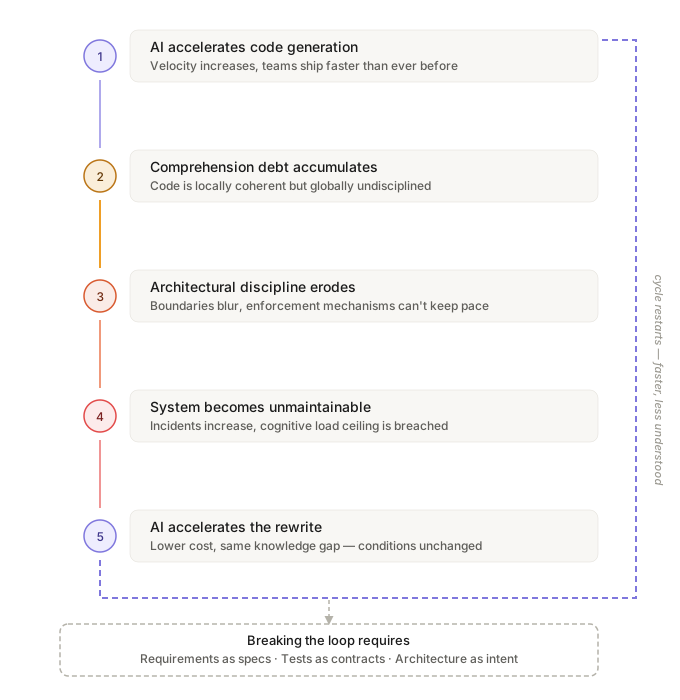 .
Breaking that loop requires treating the rewrite not as a generation problem but as a knowledge problem. Three preconditions distinguish a rewrite that produces a better system from one that restarts the same cycle faster. First, requirements must be rewritten as specifications — not inherited verbatim from the old system, but revisited, clarified, and structured with sufficient precision that AI can be held to them as verifiable constraints rather than loose guidance. Second, automated tests must encode behavior, not implementation — tests written at the right level of abstraction give AI a target that doesn’t anchor it to the old architecture, allowing a genuinely better structure to emerge. Third, architecture must be documented as machine-interpretable intent — not as a description of what was built, but as a specification of what should be built, precise enough to be encoded into the tooling that governs AI generation and validated continuously as the codebase evolves. Each of these preconditions is operationally deep enough to deserve its own treatment. How to write requirements that function as AI specifications, how to validate that AI-generated code conforms to architecture, and how to keep architecture documentation current as AI writes code at pace — these are the practical questions that follow from this article’s argument, and they will be addressed in a subsequent piece.
What Leadership Looks Like Now
For engineering leaders, the convergence of cognitive load theory, architectural history, and AI’s dual impact points toward three practices that distinguish organizations that will navigate this period well.
Treat cognitive load as a measurable architectural input, not a cultural side effect. Skelton and Pais argue that team cognitive load should be explicitly assessed before assigning system responsibilities — not estimated informally, but evaluated through structured conversations about system comprehension, change confidence, and time spent navigating versus building [2]. This discipline becomes more important as AI tools make it easier to produce code faster. Velocity is not a proxy for comprehension. A team that ships rapidly with AI assistance but cannot confidently reason about what it has built is not high-performing — it is accumulating comprehension debt that will surface as architectural fragility under pressure.
Encode architectural intent explicitly and maintain it continuously. AI tools follow architectural discipline only as faithfully as the context they receive encodes it. This means that architectural decisions — dependency rules, boundary definitions, domain language, ownership contracts — cannot remain implicit in team norms and individual judgment. They must be encoded in the tools and contexts that shape AI generation: system prompts, linting rules, architectural fitness functions, and code review criteria that specifically evaluate architectural coherence rather than just functional correctness. Ford, Parsons, and Kua’s concept of architectural fitness functions — automated checks that validate architectural properties over time — becomes significantly more valuable in an environment where generation volume can outpace human review [15].
Evaluate rewrites on knowledge, not cost. The economic case for rewrites has strengthened. The knowledge case has not changed. Before committing to an AI-assisted rewrite, engineering leaders should be able to answer: does the team understand the existing system’s domain behavior well enough to replicate it intentionally? Does it understand the failure modes well enough to avoid them? If the answer to either question is no, the rewrite is not yet viable regardless of its cost — and the prerequisite investment is in comprehension, not generation.
Conclusion: The Ceiling Didn’t Disappear. It Moved.
Software architecture has never been primarily a technical discipline. It has always been a human capacity discipline — an ongoing negotiation between the complexity of the systems we need to build and the cognitive limits of the people who build them. Every significant architectural shift in the industry’s history has been, at its core, an attempt to keep that negotiation from becoming a rout.
AI has changed the terms of that negotiation in ways that are genuinely new. It has expanded what small teams can build and accelerated what large teams can ship. It has introduced tools that reduce extraneous cognitive load on routine development work in ways that are measurably real. These are meaningful gains, and dismissing them in favor of a purely cautionary narrative would be intellectually dishonest.
But AI has also introduced comprehension debt at a scale and speed that existing architectural governance is not equipped to detect. It has disrupted Conway’s Law in ways that make organizational and system alignment harder to maintain. It has made the disciplines that manage cognitive load harder to enforce at the pace it enables. And it has lowered the cost barrier on rewrites without lowering the knowledge barrier — creating the conditions for a new generation of legacy systems built faster, understood less, and hitting their cognitive ceiling sooner than any that came before.
The organizations that navigate this well will not be those that adopt AI most aggressively or resist it most cautiously. They will be those that understand what AI actually does to the cognitive load ceiling — where it genuinely lifts it, where it quietly raises it in disguise, and where it has rendered old assumptions about cost and discipline obsolete without rendering the underlying problems obsolete along with them.
What makes a partnership survive difficult terrain is rarely that both partners make the right calls. The reckless partner is not simply reckless — beneath the chaos is a genuine desire to get the job done, to solve the problem in front of them, to protect what matters. That does not make the recklessness harmless. It makes it harder to argue against, because the intent is real. And the responsible partner, over time, is not simply responsible — exposed long enough to the velocity and the results, they begin to absorb the habits of the reckless one. Not out of negligence but out of pressure, out of the intoxicating evidence that it seems to be working, out of not wanting to be the person who slows everything down. Both partners drift. Both make decisions they later regret. What holds them together is not a clean record of good judgment. It is the commitment to carry the consequences side by side.
There is a question that the responsible partner eventually asks — quietly, without accusation, but with the full weight of someone who has been covering for everyone else for a long time: when is anyone going to cover me? It is the question engineering teams are beginning to ask about AI adoption. They have covered for code they did not fully author. They have covered for architectural drift they did not fully cause. They have covered during incidents at 2am when systems built faster than they were understood finally broke in ways nobody anticipated. They have absorbed the cognitive load, the comprehension debt, and the consequences — while the velocity was celebrated and the shortcuts were encouraged. The question of who covers the team is not a complaint. It is the most important organizational accountability question in AI-assisted software development, and most leadership conversations about AI have not yet seriously asked it.
The relationship between engineering teams and AI is arriving at that kind of moment. The decisions that led here were made under real pressure by people doing their best with what they had. Some of those decisions will turn out to be wrong. The comprehension debt will surface. The architectural drift will become visible. The rewrites will come. What determines whether organizations survive those moments is not whether they placed the perfect bet on AI early. It is whether they have built the discipline, the shared understanding, and the genuine accountability — in both directions — to face the consequences of imperfect decisions together. To cover each other. To keep moving.
The ceiling has not disappeared. It has moved. And in some places, it has become harder to see.
That is precisely when it matters most to look for it — together.
Sources & Further Reading
[1] Sweller, J. (1988) — Cognitive Load During Problem Solving: Effects on Learning Cognitive Science, 12(2), 257–285. The foundational paper introducing Cognitive Load Theory and distinguishing intrinsic, extraneous, and germane load as distinct components of working memory burden.
[2] Skelton, M. & Pais, M. (2019) — Team Topologies: Organizing Business and Technology Teams for Fast Flow IT Revolution Press. Establishes cognitive load as a first-class constraint in team and system design, with practical frameworks for assessing and managing cognitive load across engineering organizations.
[2a] Brooks, F.P. (1975) — The Mythical Man-Month: Essays on Software Engineering Addison-Wesley. The foundational work arguing that conceptual integrity — a unified, coherent vision of the system — is the most important consideration in system design. An early articulation of what cognitive load theory would later formalize: that systems must remain within the cognitive reach of the people responsible for them.
[3] Newman, S. (2015) — Building Microservices: Designing Fine-Grained Systems O’Reilly Media. The definitive practitioner guide to microservices architecture, covering service decomposition, inter-service communication, and the organizational conditions under which microservices deliver value.
[4] Google Cloud / DORA — State of DevOps Reports Annual large-scale industry research on software delivery performance, consistently demonstrating the relationship between team autonomy, deployment frequency, and organizational outcomes.
[5] Fowler, M. — Microservices Premium martinfowler.com. Articulates the overhead cost of microservices architecture and the threshold at which that overhead becomes justified by organizational benefits.
[6] Martin, R.C. (2017) — Clean Architecture: A Craftsman’s Guide to Software Structure and Design Prentice Hall. Presents the dependency rule and clean architecture principles, drawing on Cockburn’s earlier work on hexagonal architecture and ports-and-adapters.
[7] Beck, K. & Fowler, M. — YAGNI (You Aren’t Gonna Need It) martinfowler.com. Articulates the Extreme Programming principle against speculative generality, arguing that structure introduced ahead of demonstrated need consistently produces higher costs than deferring it.
[8] Evans, E. (2003) — Domain-Driven Design: Tackling Complexity in the Heart of Software Addison-Wesley. The foundational text introducing bounded contexts, ubiquitous language, and the aggregate pattern as tools for aligning software structure with domain complexity.
[9] Vernon, V. (2013) — Implementing Domain-Driven Design Addison-Wesley. Practical guidance on applying DDD in real-world systems, with case studies demonstrating both the benefits of full adoption and the organizational investment it requires.
[10] Yetiştiren, B., Özsoy, I., Ayerdem, M. & Tüzün, E. (2023) — Evaluating the Code Quality of AI-Assisted Code Generation Tools: An Empirical Study on GitHub Copilot, Amazon CodeWhisperer, and ChatGPT arXiv:2304.10778. Empirical study evaluating the code quality of major AI generation tools across validity, correctness, security, reliability, and maintainability metrics — finding consistent code smell accumulation and technical debt in AI-generated code, with maintainability issues present across all tools studied.
[11] Conway, M.E. (1968) — How Do Committees Invent? Datamation, 14(4), 28–31. The original statement of Conway’s Law, observing that organizations design systems that mirror their communication structures — a dynamic that AI-assisted development disrupts in ways not previously encountered.
[12] Spolsky, J. (2000) — Things You Should Never Do, Part I Joel on Software. The landmark essay establishing the “never rewrite” doctrine, grounded in the economic and knowledge costs of discarding working systems — costs that AI has partially but not wholly changed.
[13] Erlikh, L. (2000) — Leveraging Legacy System Dollars for E-Business IT Professional, 2(3), 17–23. IEEE Computer Society. Documents the consistent underestimation of implicit knowledge embedded in legacy systems, a failure mode elevated in AI-assisted codebases where generation outpaces comprehension.
[14] Caudill, H. (2019) — Lessons from 6 Software Rewrite Stories Medium. Comparative analysis of software rewrite outcomes identifying deep domain and failure-mode knowledge as the distinguishing property of successful rewrites.
[15] Ford, N., Parsons, R. & Kua, P. (2017) — Building Evolutionary Architectures: Support Constant Change O’Reilly Media. Introduces architectural fitness functions as automated mechanisms for continuously validating architectural properties, a practice of increased importance when AI generation volume can outpace human architectural review.
[16] Tornhill, A. & Borg, M. (2022) — Code Red: The Business Impact of Code Quality — A Quantitative Study of 39 Proprietary Production Codebases IEEE/ACM International Conference on Technical Debt (TechDebt), pp. 11–20. Peer-reviewed empirical study across 39 production codebases demonstrating that low-quality code contains 15 times more defects and takes on average 124% longer to resolve issues — establishing automated code health assessment as a measurable, business-relevant signal for architectural decay.