
There and Back Again — from Cloud to On-Prem, Projects to Products
Software organizations do not scale by following a single best practice indefinitely. Decisions that enable speed and survival in early stages—cloud-first infrastructure, project-driven delivery, lightweight processes, and generalist roles—often become sources of friction as teams, customers, and systems grow. What appears to be a return to “square one” is rarely regression; it is a recalibration driven by new economic, operational, and organizational realities. Much like a journey there and back again, experienced software leaders recognize that sustainable growth depends on knowing when to revisit earlier choices—not to repeat them, but to apply them with greater discipline and intent.
The diagram below summarizes the recurring cycles discussed throughout this article.
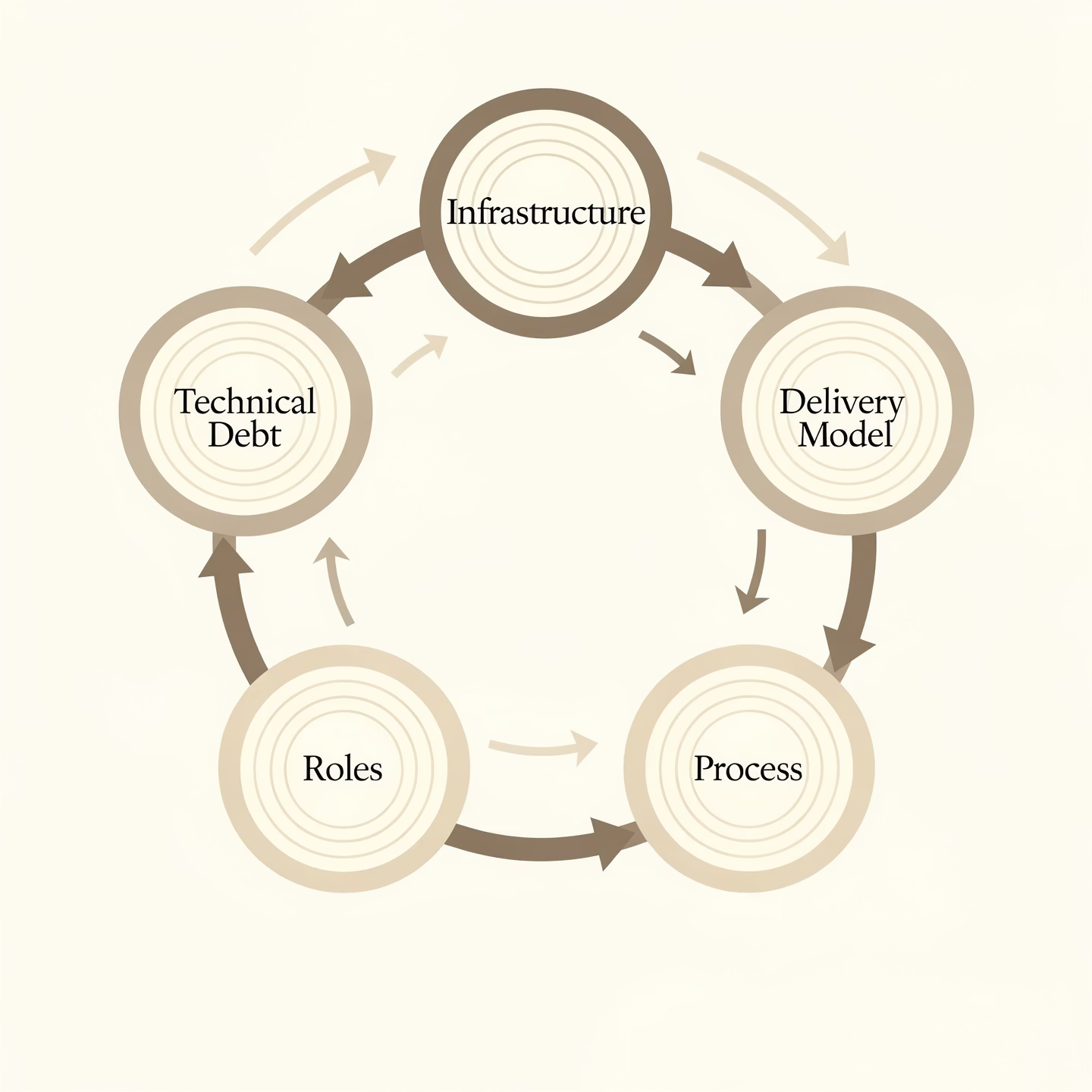 Five recurring cycles in software organization evolution
Cloud vs On-Prem Infrastructure Evolution
The first place this cyclical pattern becomes visible is infrastructure. Few decisions feel as definitive—or as emotionally charged—as the choice between cloud and on-prem. Yet across startups, scale-ups, and mature software houses, infrastructure strategy repeatedly follows the same arc: cloud first, then self-hosted, and eventually back to cloud again. This pattern is not anecdotal; it is repeatedly observed in academic research and industry surveys examining long-term cost structures, operational complexity, and organizational maturity.
Phase 1 — Startup Mode: Cloud-First by Necessity
In the earliest stage, infrastructure decisions are driven almost entirely by survival. Small teams—typically between two and twenty engineers—default to cloud-hosted tooling such as GitHub or GitLab SaaS, managed CI/CD pipelines, hosted issue trackers, and fully managed databases.
This choice is pragmatic rather than strategic. Cloud platforms eliminate upfront capital expenditure, require minimal DevOps maturity, and allow teams to focus on shipping features instead of running systems. Industry analyses consistently show that startups favor cloud infrastructure because it converts capital expenses into operating expenses and dramatically reduces time-to-market [1].
At this stage, unit economics and long-term total cost of ownership are secondary concerns. Speed, optionality, and survival dominate decision-making.
Cloud, here, is less a strategy and more a survival hack.
Phase 2 — Growth Mode: When Cloud Becomes “Quietly Expensive”
As organizations grow into the 20–200 engineer range, the economics begin to shift. What once felt frictionless starts to reveal hidden costs. CI minutes grow exponentially, storage and artifact repositories expand rapidly, and per-user SaaS pricing compounds across teams. Compliance, data residency, and security requirements introduce constraints that were irrelevant in the startup phase.
This is typically the point where finance begins questioning infrastructure spend: Why is our tooling cost growing faster than revenue?
In response, engineering teams often start self-hosting parts of the stack—Git servers, CI runners, artifact repositories—because steady, predictable workloads make on-premise or self-managed infrastructure appear financially attractive. This perception is supported by both academic and industry research. Fisher (2018) [2] demonstrates that while cloud solutions are cheaper in early years, on-premise infrastructure can be significantly less expensive over long time horizons, with total costs dropping to nearly 56% of cloud costs after ten years for stable workloads.
Industry cost analyses and practitioner reports reinforce this finding, particularly where utilization is high and elasticity offers limited benefit [3][4].
At this stage, moving away from the cloud is often seen as a sign of maturity—a correction to early convenience-driven decisions.
Phase 3 — Scale Mode: Operational Complexity Takes Over
As software houses scale further—beyond 200 engineers or across multiple business units—the dominant constraint shifts again. This time, it is no longer primarily about infrastructure cost.
Operational complexity becomes the real bottleneck.
Self-hosted systems proliferate: version control, CI/CD, wikis, ticketing platforms, monitoring stacks, identity systems. Each requires upgrades, backups, disaster recovery planning, security patching, and dedicated operational ownership. Over time, specialized teams emerge whose primary responsibility is simply keeping internal platforms running, while critical knowledge becomes concentrated in small silos.
At this scale, cognitive load and organizational risk outweigh raw infrastructure savings.
This is where the pendulum swings back. Mature organizations increasingly return to cloud platforms—not to reduce costs, but to simplify governance and reduce operational drag. Large-scale surveys and enterprise studies show that most organizations eventually adopt hybrid models, combining on-prem and cloud workloads to balance cost efficiency, compliance, and operational resilience [5].
Cloud, at this stage, is no longer about speed. It becomes a governance and complexity management tool.
Key Insight: The recurring cloud-to-on-prem-and-back cycle reveals a deeper truth: infrastructure cost is rarely the root problem—organizational complexity is.
As teams grow, the “right” infrastructure choice changes—not because earlier decisions were wrong, but because scale fundamentally alters the optimization landscape [6].
Project-to-Product Evolution
A second, equally persistent cycle appears in how software houses deliver value. Many organizations begin by building bespoke solutions for individual customers, evolve toward productization to gain leverage, and eventually find themselves constrained by the very products that once enabled their growth. This pattern is not anecdotal; it is well documented in both academic research and industry practice examining how software firms transition from customer-specific development to market-oriented product models.
Phase 1 — Project-Driven Beginnings
Most software houses start as project-driven organizations. Early teams build exactly what customers ask for, optimize for delivery speed, and tie revenue directly to individual engagements. This approach provides immediate benefits: fast cash flow, deep customer understanding, and highly adaptable engineering teams.
Academic research describes this phase as customer-specific software development, where solutions are tightly coupled to individual clients rather than a broader market [7]. For young companies, this model is not a weakness—it is a rational response to uncertainty, allowing teams to learn quickly and establish credibility.
The limitations emerge gradually. Each project largely starts from zero, reuse is minimal, and scale is achieved primarily by adding people. Engineering leverage remains low, and margins are constrained by delivery capacity.
Phase 2 — Productization for Leverage
As similar projects repeat, patterns begin to emerge. Teams identify common components, shared architectures take shape, and internal frameworks evolve into platforms. Over time, this reuse becomes intentional, and a product is born.
This transition—from bespoke projects to product software—is formally described in the software engineering literature as productization [7][8]. Empirical case studies show organizations moving through identifiable stages: independent projects, reuse across projects, product recognition, and eventually product platforms [7]. As companies progress through these stages, they introduce software product management practices such as roadmapping, release planning, and market-driven requirements.
The benefits are significant. Productization enables reuse, predictable delivery, improved margins, and sales scalability. This is the point at which many software houses begin operating as product companies rather than service providers.
Industry perspectives reinforce this shift. Mik Kersten’s Project to Product frames this evolution as a move away from funding individual projects toward optimizing value streams, enabling organizations to scale delivery without scaling headcount at the same rate [9].
Phase 3 — Product Maturity Becomes Rigidity
Over time, mature products tend to harden. Architectures stabilize, customization paths narrow, and change becomes slower and more expensive. What once enabled scale begins to constrain flexibility.
At this stage, customers increasingly seek differentiation, faster turnaround, and workflows tailored to their specific needs. Instead, they often hear: That’s not supported—you’ll need to adapt your process to the product.
Research on evolving software product lines highlights this tension explicitly. As products mature, customization becomes more complex and costly, particularly when variability was not designed into the architecture early on [10]. Consulting research reaches a similar conclusion: firms that over-standardize often struggle to balance customization value against the operational cost of complexity [11].
The outcome is predictable. Some customers drift away, and new software houses emerge offering bespoke solutions once again. The cycle restarts—not because productization failed, but because no single delivery model optimizes for both scale and differentiation indefinitely.
Key Insight: Products optimize for scale. Bespoke solutions optimize for differentiation.
No single model wins forever.
The project-to-product cycle is not a linear maturity path with a final destination—it is a recurring recalibration driven by changing market, customer, and organizational constraints.
Process Evolution
The cyclical nature of software organizations becomes especially visible in how delivery processes evolve. Over the past several decades, teams have repeatedly shifted from structured, plan-driven models to lighter, iterative approaches—only to later reintroduce structure in new forms. This evolution is not random; it reflects how organizations respond to changing scale, risk, and coordination challenges [12][13].
Phase 1 — Structured Processes for Predictability
Early large-scale software efforts favored highly structured, sequential models such as Waterfall. These approaches emphasized upfront planning, documentation, and formal handoffs in an attempt to control complexity and risk. Historically, this model was particularly attractive to regulated industries and large institutions, including government and defense organizations [14].
At smaller scales, this structure often proved heavy-handed. Long feedback cycles delayed learning, and teams struggled to adapt to changing requirements. As markets accelerated and software became more customer-facing, the limitations of rigid, upfront planning became increasingly visible.
Phase 2 — Agile and DevOps as a Reaction to Rigidity
Agile methodologies emerged as a direct response to the constraints of plan-heavy processes. By prioritizing working software, short feedback loops, and close collaboration, Agile promised speed, adaptability, and higher customer satisfaction. Later, DevOps extended this thinking by integrating development and operations, reducing deployment friction, and improving delivery throughput [12][15].
Large-scale industry studies, including DevOps maturity and performance research, show that these practices deliver substantial benefits when adopted effectively. Teams report faster deployment cycles, improved reliability, and stronger alignment between technical and business outcomes [15].
However, as Agile and DevOps scaled across entire organizations, new problems surfaced. Coordination across multiple teams, regulatory compliance, dependency management, and long-term planning reintroduced complexity. What began as a lightweight process often accumulated layers of ceremony, tooling, and governance—ironically recreating some of the rigidity Agile originally sought to eliminate.
Phase 3 — Hybrid Models and the Return of Structure
At scale, many organizations do not abandon Agile—but they adapt it. Hybrid delivery models emerge, blending Agile practices with traditional planning and governance mechanisms. Research and industry case studies consistently show large enterprises combining Waterfall-style stage gates with Agile execution to manage risk, especially where legacy systems or regulatory constraints exist [16][17].
Professional bodies such as the Project Management Institute (PMI) explicitly acknowledge this trend, noting that successful organizations are not choosing between Agile and Waterfall permanently, but intentionally blending them based on context [16]. Peer-reviewed research reinforces this view, identifying hybrid models as an increasingly common and effective response to competing demands for predictability and flexibility [18].
The result is a familiar pattern: organizations move from rigid structure to flexibility, then reintroduce structure—this time informed by experience and adapted to scale.
Key Insight: Process evolution in software organizations is not a linear progression toward a “best” methodology.
Processes are adopted to solve today’s dominant problems—speed, quality, coordination—but each solution introduces new constraints at scale. As those constraints grow, organizations adjust again, often revisiting earlier ideas in modified form.
What looks like regression is usually recalibration.
Role Evolution Cycle
As software organizations scale, the way roles are defined and organized evolves in predictable—and recurring—patterns. Early teams favor generalists who do everything. Growth introduces specialization to reduce risk and increase reliability. At larger scales, however, specialization itself becomes a bottleneck, driving organizations back toward integrated, cross-functional or platform-oriented team models. This evolution is not linear; it is cyclical, shaped by tooling maturity, organizational friction, and delivery constraints [19][20].
Phase 1 — Generalists by Necessity
In early-stage software teams, roles are fluid. Developers write code, deploy it, debug production issues, and often interact directly with customers. This generalist model is not ideological—it is practical. Small teams lack the scale to support specialized roles, and modern tooling lowers the barrier to participating across the delivery lifecycle.
Industry commentary on role evolution notes that early engineers are often “full-stack by default,” covering wide functional areas out of necessity rather than preference [21]. At this stage, autonomy is high, coordination overhead is low, and speed matters more than formal role boundaries.
Phase 2 — Specialization to Manage Scale
As systems grow more complex and uptime expectations increase, organizations introduce specialization. Dedicated roles emerge: DevOps engineers, SREs, QA specialists, security engineers, and release managers. Each role addresses a real scaling pain—deployment failures, operational instability, quality regressions, or compliance risk.
Google’s Site Reliability Engineering (SRE) model is a canonical example of this phase. SRE reframed operations as an engineering discipline, introducing explicit reliability targets, automation, and error budgets to manage production risk at scale [19]. Similarly, DevOps practices formalized responsibilities that were previously implicit, creating clearer ownership and accountability.
Academic research on Agile and DevOps transitions supports this pattern, showing that role differentiation often accompanies process and tooling maturity as organizations attempt to stabilize delivery and reduce operational risk [22].
Phase 3 — Specialization Becomes Friction
Over time, specialization introduces its own costs. Handoffs multiply, feedback loops slow, and ownership becomes fragmented. Developers wait on other teams to deploy, debug, or provision environments. Throw it over the wall dynamics quietly reappear—this time between internal specialists rather than departments.
Industry analyses of DevOps and role maturity repeatedly note this inflection point. As organizations add more specialized roles, coordination overhead increases and local optimizations begin to harm end-to-end flow [20][23]. The very roles created to improve delivery now constrain it.
This pressure drives a structural shift.
Phase 4 — Recomposition into Cross-Functional and Platform Teams
To reduce friction, organizations reorganize again—this time recomposing roles into cross-functional product teams or platform teams that internalize operational responsibility. Instead of central DevOps or SRE teams acting as gatekeepers, platforms provide paved roads, and product teams regain autonomy within guardrails.
This shift aligns with the rise of T-shaped engineers—individuals with deep expertise in one area and sufficient breadth to collaborate effectively across disciplines [24][25]. Modern automation, cloud platforms, and AI-assisted tooling further lower the cost of recombining responsibilities, enabling teams to operate with fewer handoffs than before.
Historical analyses of role evolution explicitly document this pendulum: specialist-heavy models solve scaling problems, then give way to integrated team structures once coordination becomes the dominant bottleneck [20][24].
Key Insight: Role evolution in software organizations is a balancing act between autonomy and stability.
Organizations oscillate between generalists and specialists not because one model is superior, but because each solves a different scaling problem—and creates the next one.
What appears to be a return to earlier role models is usually a recomposition informed by better tooling, clearer boundaries, and hard-earned experience.
Technical Debt Accumulation Curve
Among all the cycles software organizations experience, technical debt is the most persistent—and the most misunderstood. Teams knowingly incur it to move fast, struggle under its weight as systems grow, and eventually face a reckoning: invest in sustained remediation or attempt a risky rebuild [26][27].
Phase 1 — Intentional Debt in the Name of Speed
The concept of technical debt was originally articulated by Ward Cunningham to describe the trade-off between rapid delivery and long-term code quality. Like financial debt, it allows teams to move faster in the short term, with the expectation that the cost will be paid back later [26].
In early-stage products and startups, this trade-off is often rational. Delivery pressure, limited resources, and uncertain requirements incentivize shortcuts: hard-coded assumptions, minimal abstractions, deferred refactoring, and sparse documentation. Empirical research confirms that startups accumulate disproportionately higher levels of technical debt due to these constraints [28].
At this stage, debt is largely invisible. Velocity remains high, and the system still fits in the team’s head.
Phase 2 — Growth Turns Debt into Drag
As the codebase grows and teams expand, technical debt stops being theoretical. Changes take longer, defects increase, and onboarding new engineers becomes expensive. What was once a local shortcut becomes a systemic constraint.
Recent empirical studies show that technical debt grows non-linearly as projects evolve, significantly increasing future development effort and complexity [27]. Longitudinal analyses of issue trackers and repositories reveal that technical debt items often remain unresolved for long periods, accumulating interest in the form of slower delivery and higher defect rates [29].
At this stage, organizations typically respond with refactoring initiatives, architectural cleanups, or modernization programs. These efforts reduce debt temporarily—but rarely eliminate it entirely.
Phase 3 — Rewrite Temptation and the Point of No Return
When incremental remediation no longer feels sufficient, teams begin discussing the ultimate reset: a rewrite from scratch.
History shows that this moment recurs across generations of software companies. The late 1990s Netscape rewrite, famously chronicled by Joel Spolsky, established the industry’s early doctrine: never rewrite your software [30]. Subsequent decades reinforced this cautionary stance as many large-scale rewrites failed spectacularly—often due to underestimated scope, shifting requirements, or organizational fragmentation [31].
Yet the story is not one-sided. Some organizations have successfully rewritten major systems under specific conditions: strong executive alignment, disciplined scope control, and long-term investment. Case studies from companies such as Basecamp, Adobe, and Microsoft (VS Code) demonstrate that rewrites can succeed—but only when treated as strategic, organization-wide commitments rather than engineering side projects [32].
Empirical and consulting research suggests that most rewrites fail not because rewriting is inherently wrong, but because technical debt is a symptom of deeper organizational and process issues that rewriting alone does not solve [33].
Phase 4 — Debt Re-accumulates Under New Pressures
Even successful rewrites do not end the cycle. New architectures introduce new assumptions. Market pressure returns. Teams optimize for speed again.
McKinsey research estimates that technical debt accounts for 20–40% of the value of the entire technology estate, with a majority of CIOs reporting that debt continues to rise year over year [34]. This creates renewed pressure for shortcuts—and the cycle begins again.
Technical debt, in practice, is not a problem to be solved once. It is a force to be continuously managed.
Key Insight: Technical debt behaves like a lifecycle, not a defect.
Teams incur it intentionally to deliver value quickly, suffer its consequences as systems scale, and periodically attempt to reset through refactoring or rebuilds. The pattern repeats not because teams fail to learn—but because growth, competition, and time-to-market pressures never disappear.
The real differentiator is not whether an organization accumulates technical debt, but whether it builds the discipline to service it continuously.
Conclusion: Cycles as a Source of Strength
Software organizations do not struggle because they revisit earlier decisions; they struggle when they expect growth to be linear and permanent answers to exist. The patterns explored here—shifting infrastructure strategies, moving between projects and products, evolving processes, redefining roles, and accumulating technical debt—are not signs of confusion or failure. They are predictable responses to changing constraints as organizations scale.
Each phase in these cycles solves a real problem. Cloud platforms enable speed before cost and governance matter. Productization creates leverage before differentiation becomes critical. Agile and DevOps improve flow before coordination and control dominate. Specialized roles stabilize systems before silos slow them down. Technical debt accelerates delivery before it compounds into drag. None of these choices are inherently wrong. They become problematic only when treated as final destinations rather than context-dependent tools.
At its core, this is a story of continuous improvement rather than straight-line progress. Agile, in its original sense, is not a set of ceremonies or frameworks but a mindset grounded in feedback, learning, and adaptation. Organizations that endure are not those that avoid cycles, but those that move through them deliberately—recognizing when yesterday’s strengths have become today’s constraints, and adjusting without thrashing or denial.
In evolutionary terms, survival favors not the strongest or the most sophisticated, but the most adaptable. Software houses that persist are rarely the ones with the most advanced tooling or the most rigidly enforced processes. They are the ones that develop judgment—knowing when to standardize and when to customize, when to centralize and when to empower, when to pay down debt and when to accept it consciously.
Much like There and Back Again, the journey matters less for where it begins or ends than for what is learned along the way. Bilbo returns from his first adventure not simply changed, but prepared—better equipped to recognize danger, make decisions, and navigate uncertainty when the next challenge arrives. Software organizations follow the same path. Each cycle, when navigated intentionally, leaves them wiser and more capable than before.
Progress in software is rarely about finding the right final state. It is about building the ability to return—again and again—with greater understanding, sharper judgment, and the resilience to face whatever comes next.
Sources & Further Reading
[1] Sosuv Consulting — Selecting the Best Option for Startups: On-Premises vs Cloud Solutions
Explores why startups overwhelmingly choose cloud early on and why those decisions are often revisited as organizations scale.
[2] Cameron Fisher (2018) — Cloud versus On-Premise Computing
American Journal of Industrial and Business Management.
A detailed total cost of ownership (TCO) analysis showing how cloud solutions can be cheaper initially but significantly more expensive than on-premise infrastructure over long, stable usage periods.
[3] Computer Weekly — Reverse cloud migrations: Why some enterprises are shifting their IT back on-premise Reports on IDC survey data showing a significant percentage of enterprises planning partial or full cloud reversals.
[4] Campus Technology (September 2024) — Are Organizations Moving from Cloud to On-Premises?
Cites a Citrix study indicating that many organizations are reconsidering cloud-first strategies.
[5] Terrazone — On-Prem vs Cloud: Total Cost of Ownership (TCO)
Comparative analysis emphasizing scenarios where predictable workloads favor self-managed infrastructure.
[6] IDC (Industry Surveys) — Hybrid Cloud Adoption Trends IDC research showing most enterprises operate hybrid environments as they mature.
[7] Leenen et al. (2012) — Transforming to Product Software: The Evolution of Software Product Management Processes Springer / Utrecht University.
Foundational academic study on software productization stages.
[8] Artz, van de Weerd, Brinkkemper (2010) — Productization: Transforming from Developing Customer-Specific Software to Product Software Classic academic framing of the project-to-product transition.
[9] Mik Kersten (2019) — Project to Product
Industry perspective on shifting from project funding to value-stream optimization.
[10] Empirical Software Engineering (2022) — Visualizing the Customization Endeavor in Product-Based Software
Academic research on customization challenges in mature software products.
[11] Strategy+Business (Booz Allen Hamilton) — Smart Customization: Profitable Growth Through Tailored Business Streams
Research on balancing customization value against complexity costs.
[12] Xorbix — The Evolution of Software Development Methodologies
High-level overview of Waterfall → Agile → DevOps evolution.
[13] Lehman, M. M. — Laws of Software Evolution Foundational theory describing software systems and processes as feedback-driven systems.
[14] Wikipedia — Waterfall Model
Documents institutional use and later evolution toward iterative models.
[15] Google Cloud / DORA — State of DevOps Reports
Large-scale industry research on DevOps maturity and organizational evolution.
[16] Project Management Institute (PMI) — Blending Agile and Waterfall Professional guidance on hybrid delivery models.
[17] Deloitte (via PMI case studies) — Hybrid Agile-Waterfall Delivery Enterprise case studies showing hybrid process adoption.
[18] IEEE (2022) — The Waterfall Model with Agile Scrum as the Hybrid Agile Model Peer-reviewed study supporting hybrid methodology adoption.
[19] Google — Site Reliability Engineering
Foundational material on the emergence of SRE as a scaling response.
[20] DORA / Google Cloud — DevOps Role & Maturity Research Surveys documenting recurring organizational and role evolution patterns.
[21] Ciro Rizzo — The Evolution of the Software Engineering Role
Industry view on how engineering roles have expanded and recombined.
[22] Jovanović et al. — Agile Transition and Adoption Frameworks Systematic mapping study of role and process changes during Agile adoption.
[23] Waydev / ThoughtWorks — DevOps & Platform Team Maturity Industry analysis of over-specialization and recomposition into platform teams.
[24] Alex Kondov — The T-Shaped Engineer Perspective on the shift back toward generalist skill sets.
[25] Wikipedia — T-shaped Skills
Documents evolving skill models in organizations.
[26] Wikipedia — Technical Debt
Foundational overview of Ward Cunningham’s metaphor.
[27] Gupta et al. (2025) — Measuring the Impact of Technical Debt on Development Effort
Empirical study quantifying technical debt impact.
[28] Klotins et al. (2023) — Exploration of Technical Debt in Start-ups
Study showing higher debt accumulation in startups.
[29] Runeson et al. (2023) — Lifecycle of Technical Debt
Longitudinal analysis of debt accumulation and remediation.
[30] Joel Spolsky (2000) — Things You Should Never Do, Part I
Landmark essay on rewrite risks.
[31] Morphis Insights — Rewrite Code from Scratch? Case studies of large-scale rewrite failures.
[32] Aaron Hardy (2019) — We Decided to Rewrite Our Software Adobe’s successful rewrite case study.
[33] Herb Caudill (2019) — Lessons from 6 Software Rewrite Stories
Comparative analysis of rewrite outcomes.
[34] McKinsey & Company — The Cost of Technical Debt Estimates technical debt at 20–40% of total technology estate value.