
Why Git Branching Is a Strategic Decision
Managing Git branching in product organizations — especially in fintech and other regulated domains — is not a tooling choice. It is a systems-level decision that directly influences delivery speed, stability, auditability, and engineering culture.
As products mature, teams must support:
- Multiple customers on different versions
- Customer-specific behavior and regulatory requirements
- Parallel product development and production support
- Emergency fixes under strict SLAs
- Long-term product evolution without fragmentation
This creates a fundamental challenge:
How do you evolve a single product while supporting multiple customer realities — without breaking either?
This post outlines a practical Git branching strategy that addresses this challenge at an organizational level.
The Core Problem Most Teams Face
Most engineering teams start with good intentions but end up in one of these extremes:
-
Over-simplified branching
Works early, collapses under scale and multiple customers. -
Over-engineered branching
Becomes slow, fragile, and intimidating for developers.
The real challenge is balancing:
- Product-centric development
- Customer-specific delivery needs
- Long-term maintainability
- Operational confidence during releases
A Systems View of Git Branching
At a systems level, a Git repository is a control plane for your product.
Your branching strategy should clearly separate:
- Product evolution (where innovation happens)
- Release stability (what customers rely on)
- Customer isolation (who gets what, and when)
This separation reduces cognitive load, enables parallel workstreams, and makes failures containable rather than systemic.
Think of branches as organizational boundaries, not just technical ones.
Product-Centric First, Customer-Centric Second
A key mindset shift is recognizing that:
Products should be the primary axis — customers are consumers of product versions, not owners of codebases.
Many organizations maintain separate repositories per customer. While this feels customer-centric, it leads to:
- Duplication of effort
- Diverging logic
- Inconsistent security posture
- Painful upgrades
A product-centric branching model keeps one source of truth, while still allowing controlled customer customization where absolutely necessary.
Scaling Without Chaos
As teams and customers grow, branching must support:
- Parallel feature development
- Controlled releases
- Emergency fixes without disruption
- Predictable promotion paths (development → release → production)
A scalable strategy minimizes long-lived divergence and makes merges intentional events, not daily firefighting exercises.
At scale, clarity beats cleverness.
Cultural Impact: Why Developers Either Love or Hate Git
Branching strategies silently shape engineering culture.
A good strategy:
- Makes the right path obvious
- Reduces fear of breaking production
- Encourages ownership and accountability
- Supports junior and senior developers equally
A bad one creates tribal knowledge, gatekeeping, and hesitation.
Git should enable flow, not demand heroics.
Governance Without Bureaucracy
In regulated industries like fintech, governance is unavoidable — but it does not need to be heavy-handed.
A well-defined branching strategy enables:
- Auditable change history
- Clear release ownership
- Controlled hotfix paths
- Clean integration with CI/CD and approval workflows
Governance should emerge naturally from structure, not manual policing.
Where This Strategy Fits Best
This approach works particularly well for organizations that:
- Build core fintech platforms or products
- Serve multiple enterprise customers
- Need controlled but frequent releases
- Aim to mature from project-led to product-led delivery
Trunk-Based Development as the Foundation
At the center of this model is trunk-based development. 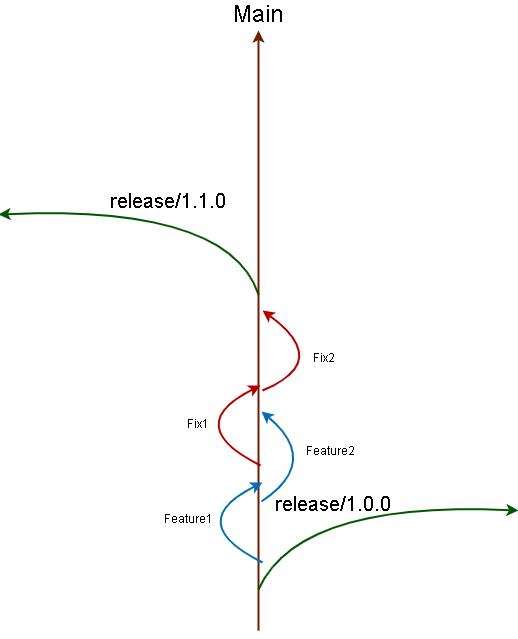 .
All product development flows through a single, continuously evolving branch:
main
The trunk represents the future of the product. It is where features are integrated, tested, and prepared for release.
Feature branches are intentionally short-lived and merged back into main frequently. This minimizes long-term divergence and keeps integration friction low.
The trunk is not frozen for customers — it exists to preserve momentum and clarity in product evolution.
Release Branches: Separating Stability from Innovation
To support customers running different versions, the product lifecycle is anchored by release branches.
Release branches represent stable snapshots of the product and are created intentionally when a version is ready for delivery.
They serve to:
- Freeze scope
- Stabilize quality
- Support certification and compliance
- Act as a base for customer deployments
Once created, release branches accept only fixes — not new features. Product innovation continues on main without disrupting delivery timelines.
Customer Branches: Controlled Customization Without Fragmentation
Enterprise customers often require:
- Custom workflows
- Regulatory adaptations
- Integration-specific behavior
- Temporary patches
Customer-specific changes must not leak into the core product by default.
For this reason, customer delivery happens on customer branches, derived from a specific release version.
This approach ensures:
- Product evolution remains clean
- Customer requirements are isolated and explicit
- Customizations are auditable and reversible
Only changes with clear product value are later generalized and merged into main.
Scenario-Based Views (How the Strategy Behaves)
The following scenarios illustrate how this branching strategy behaves in real-world situations. These are conceptual flows, not procedural steps.
Scenario 1: Standard Product Development and Release
This scenario shows how new product features flow from development into a stable release.
What this illustrates:
- Feature work merges into main
- Main continues to evolve independently
- A release branch is cut at a defined stabilization point
- Customers receive stable, versioned releases
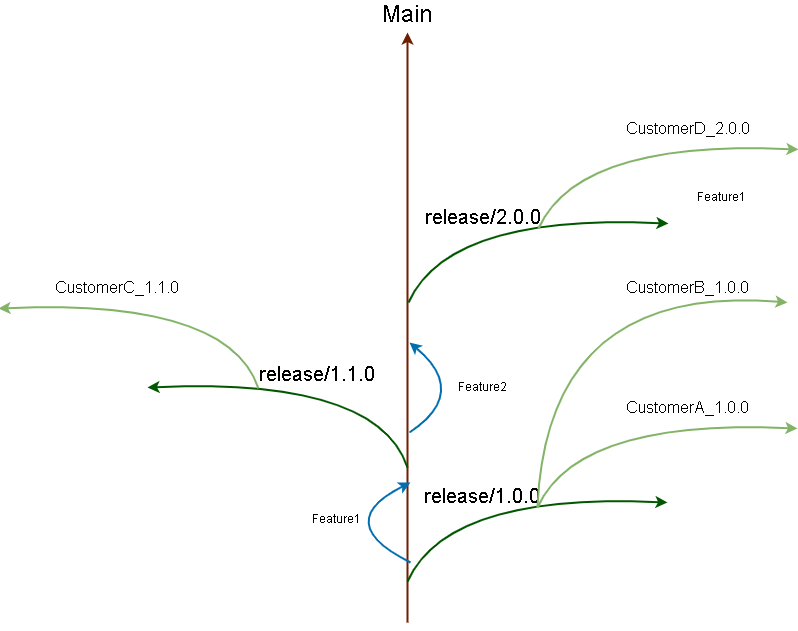
Scenario 2: Customer-Specific Customization
This scenario demonstrates how customer-specific behavior is isolated without affecting the product roadmap.
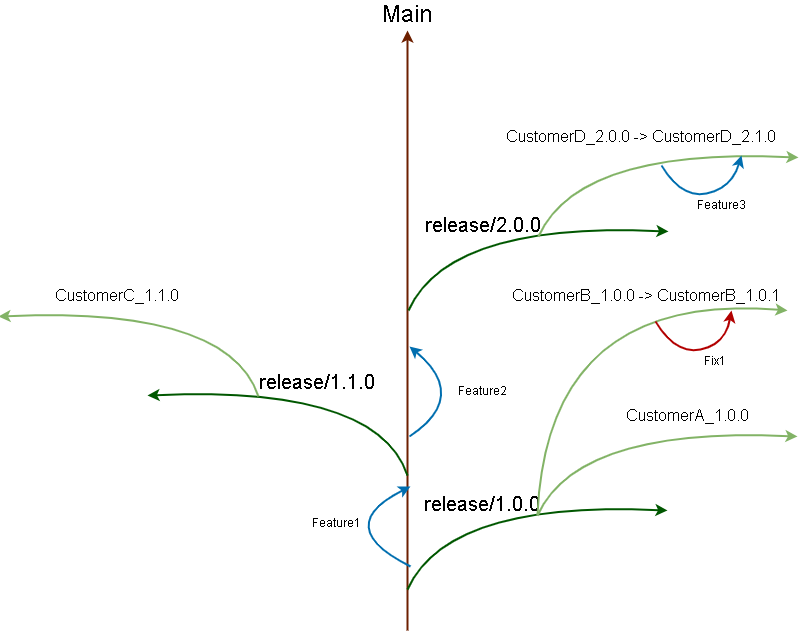
What this illustrates:
- Customer branches are created from a release
- Custom behavior remains isolated
- The core product remains unaffected
- Product evolution continues independently
Scenario 3: Product Bug Fix Propagation
This scenario shows how a product fix is applied and propagated across versions.
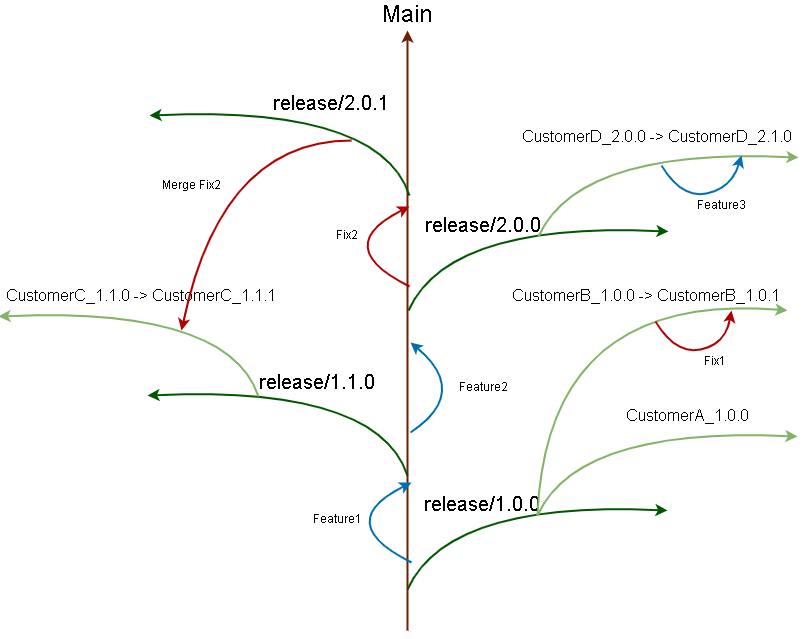
What this illustrates:
- Fixes are applied to the product first
- Stability improvements flow forward
- Customers inherit fixes without manual rework
Scenario 4: Customer Upgrade to a New Product Version
This scenario demonstrates a clean and controlled customer upgrade.
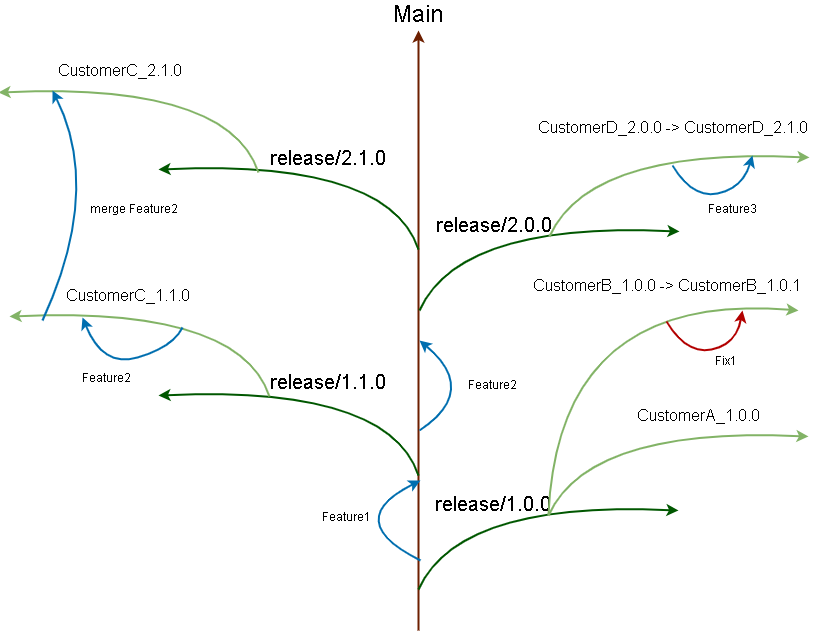
What this illustrates:
- Upgrades start from a clean new release
- Only required customer-specific changes are reapplied
- Historical complexity is intentionally discarded
Exceptional Scenarios: Handling Reality Without Breaking the System
No branching strategy operates in a perfectly controlled environment.
In long-lived product organizations, especially in fintech, exceptions are part of business-as-usual (BAU).
The goal is not to eliminate exceptions, but to ensure they do not clutter the product, distort the roadmap, or fragment the codebase over time.
Exceptional scenarios fall into two broad categories:
- BAU-driven operational exceptions
- Product-level decisions required to safeguard long-term scalability
BAU Exceptions: Operational Reality at Scale
These scenarios arise from day-to-day production support and customer operations.
Emergency Fixes That Are Also Product-Relevant
There are cases where:
- A customer faces a production issue requiring immediate resolution
- The root cause exists in core product logic
- The fix is relevant beyond a single customer
In such situations, the fix must be treated as a product fix, not a customer patch.
The guiding principles are:
- The fix ultimately belongs to the product
- Customer urgency does not override product integrity
- Temporary isolation may be necessary, but permanent divergence is not
Emergency paths must always converge back into the product flow to avoid silent forks.
Product Fixes That Break Customer-Specific Features
Product fixes, when rolled out to customers, can occasionally break:
- Customer-specific workflows
- Custom integrations
- Regulatory adaptations
This does not invalidate the product fix.
Instead:
- The product fix remains intact
- Customer branches are adjusted to restore compatibility
- The product is not reshaped to preserve isolated customer behavior by default
This preserves forward momentum while respecting customer commitments.
Product Fixes That Are Not Relevant for Certain Customers
Some customers may continue operating on very old product versions due to:
- Compliance certification cycles
- Contractual or operational constraints
- Risk tolerance within their organizations
In such cases:
- Not every product fix is automatically applicable
- Fixes are evaluated for relevance and feasibility
- If a fix can be safely adjusted, it may be backported
- Otherwise, the limitation is documented and accepted
This avoids the illusion that all versions must evolve equally.
Product Safeguard Exceptions: Protecting Long-Term Clarity
These scenarios are less about immediate operations and more about preventing long-term product clutter.
New Product Features Not Supported on Older Versions
As products evolve, new features may depend on:
- Architectural changes
- Data model evolution
- Platform capabilities not present in older releases
Supporting every historical version indefinitely is neither realistic nor healthy.
A clear support policy is required, for example:
- Only the latest version and the previous two versions (N-2) are supported
- Customers on older versions must upgrade to access new functionality
This creates a sustainable balance between customer flexibility and product evolution.
Customer Features Promoted to Product Features
Some customer-specific features prove to be broadly valuable.
When this happens:
- The feature is reassessed from a product perspective
- Assumptions tied to a single customer are removed
- The feature is generalized, hardened, and documented
- It is then introduced into the product through normal product development flow
This transforms customer-driven innovation into intentional product value, rather than accidental complexity.
The Discipline Behind Exceptional Scenarios
Exceptional scenarios should follow one unifying rule:
Exceptions may solve immediate problems, but they must not redefine the system.
Healthy systems ensure that exceptions are:
- Explicit
- Intentional
- Time-bound
- Reconciled with the product roadmap
When exceptions become frequent, informal, or permanent, the branching strategy is no longer scaling — it is eroding.
Strong product organizations absorb operational pressure without changing their shape.
Organizational Outcomes of This Strategy
Branching strategies silently shape engineering culture.
A well-designed model:
- Makes the right path obvious
- Reduces fear of breaking production
- Encourages ownership and accountability
- Supports predictable delivery
Poor branching models create hesitation, tribal knowledge, and dependency on a few senior engineers.
Git should enable flow, not demand heroics.
Closing Thoughts
This Git branching strategy is not about complexity — it is about clarity.
It enables organizations to:
- Scale product development
- Support diverse customer needs
- Maintain delivery confidence
- Protect long-term product evolution
In a follow-up post, I’ll focus on practical implementation, including branch naming, workflow rules, and CI/CD alignment.