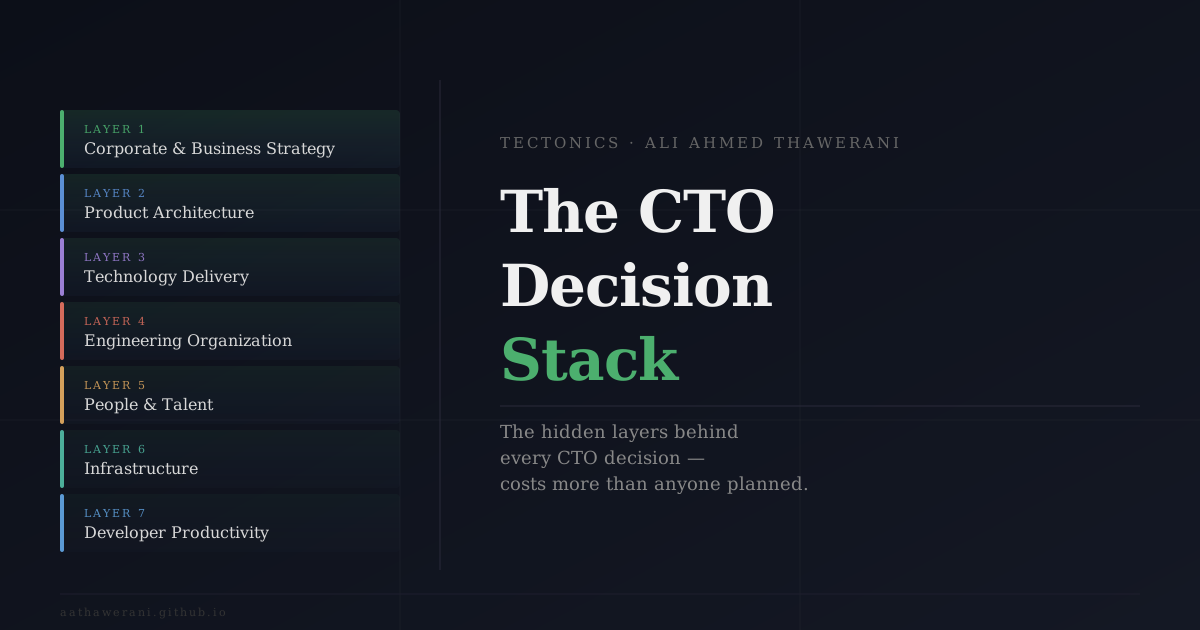
Seven layers of decision-making — and why conflating them is how technical leadership breaks down
There is a category of technical leadership failure that does not announce itself as a failure at the time it happens.
A CTO makes a call about the database. It is the right call, technically. Clean, defensible, well-reasoned. Six months later, the engineering team is reorganized around it in ways that nobody planned. The product roadmap is constrained by it. The hiring strategy has implicitly shifted because of it. The company is now three layers deep into consequences that originated from a decision that was framed, evaluated, and made as a purely technical question.
This is not a story about a bad decision. It is a story about a decision made at the wrong layer — evaluated against the wrong criteria, with the wrong people in the room, without visibility into the implications it would carry upward.
The CTO role is structurally unusual in organizations. Unlike a CFO, who operates within a fairly well-understood set of financial abstractions, or a CPO, who owns a reasonably bounded product domain, the CTO sits at an intersection between corporate strategy, product thinking, operational delivery, organizational design, people leadership, infrastructure, and developer tooling. These are not the same type of problem. They do not respond to the same reasoning. They do not decay at the same rate or carry the same reversibility.
Most technical leaders know this in principle. The difficulty is that in practice, the layers collapse. A decision that should live at one layer gets resolved at another. Strategic questions get answered by whoever happened to be in the room for a technical discussion. Infrastructure choices calcify into product constraints. A technology choice gets evaluated on architectural merit alone, without anyone asking whether the team can deliver it or sustain it in production. Developer tooling decisions accumulate into organizational culture, invisibly, over years.
The CTO Decision Stack is an attempt to make the layers explicit — not as a hierarchy of importance, but as a map of where decisions actually belong, what they are optimizing for, and how they interact with each other.
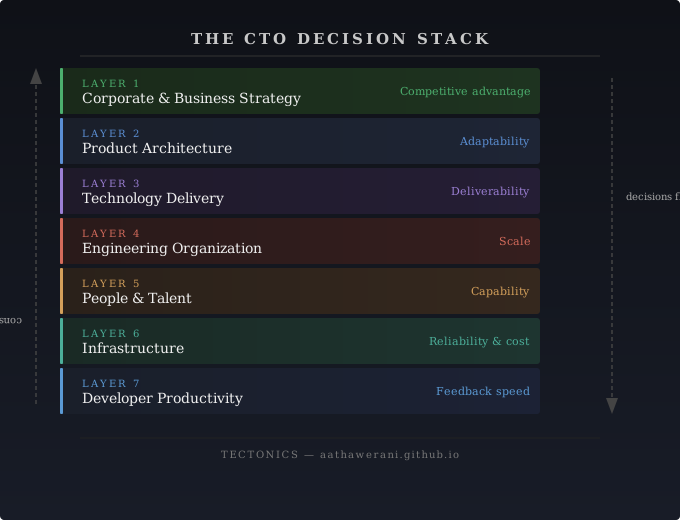
The Seven Layers
The stack runs from the highest level of abstraction to the most operational. Each layer has its own time horizon, its own reversibility profile, and its own failure mode when it is confused with another layer.
They are not independent. Every layer has load-bearing relationships with the layers above and below it. A decision at one layer creates the environment within which decisions at adjacent layers must be made. This is what makes them a stack, not a list.
Layer 1: Corporate & Business Strategy
Time horizon: Years to decades. Reversibility: Very Low.
The top layer is the one technical leaders most often underweight — not because they do not care about business outcomes, but because decisions at this layer do not feel like engineering decisions. They feel like someone else’s problem.
They are not.
This layer operates at two altitudes that are distinct but inseparable. Corporate strategy sits above business strategy. Corporate strategy asks: what is the shape of the organization itself — its portfolio of bets, its approach to M&A, its decision about which capabilities to own versus acquire versus partner on? A CTO who has not engaged with these questions will find that the answers arrive anyway, embedded in decisions made by others, and discover too late that those answers have constrained everything below.
Business strategy sits just below it, and asks the question most technical leaders are more comfortable with: what does this specific product or business unit need to be, technically, to win in its market over the next several years?
But neither question can be answered in isolation from the environment the organization operates in. External forces shape the answer before the CTO gets to ask it.
Market dynamics determine what speed of evolution is required. A market that is moving fast with low switching costs demands different architectural choices than one that moves slowly with deep integration. A CTO building for a fast market who optimizes for stability is playing the wrong game. One building for a slow market who optimizes for speed is accumulating unnecessary complexity.
Talent pool and availability constrain what is actually buildable. A technically correct strategy that requires skills the market cannot supply is not a strategy — it is a fantasy. Stack choices, hiring models, and organizational design all feed back into what the layer-one strategy can credibly commit to.
Competition and coopetition define where differentiation is actually possible. Competing head-on against a well-resourced incumbent on their strongest capability is a different strategic position than identifying the adjacent surface they cannot serve. And coopetition — building on top of a competitor’s platform, contributing to shared infrastructure with rivals, participating in industry consortia — carries its own set of layer-one decisions about what to share and what to protect.
These forces are not layers in themselves. They are the environment within which layer-one decisions are made — the constraints that make some strategies viable and others academic. The CTO’s job at this layer is not to predict external forces, which is impossible, but to make strategic decisions that are robust to a range of plausible futures rather than optimized for a single assumed one.
This is precisely the role that enterprise architects were invented to fill — the bridge between corporate strategy and technology structure. In most organizations that role is either absent, underpowered, or disconnected from real decisions. The gap does not stay empty. It fills itself with accumulated accidents: technology choices that were never evaluated against strategy, architectural decisions that carry strategic consequences nobody intended, organizational structures that reflect the company as it was rather than the company it needs to become. The CTO who does not explicitly own layer one is not avoiding the work. They are delegating it to nobody — and discovering later that nobody did it.
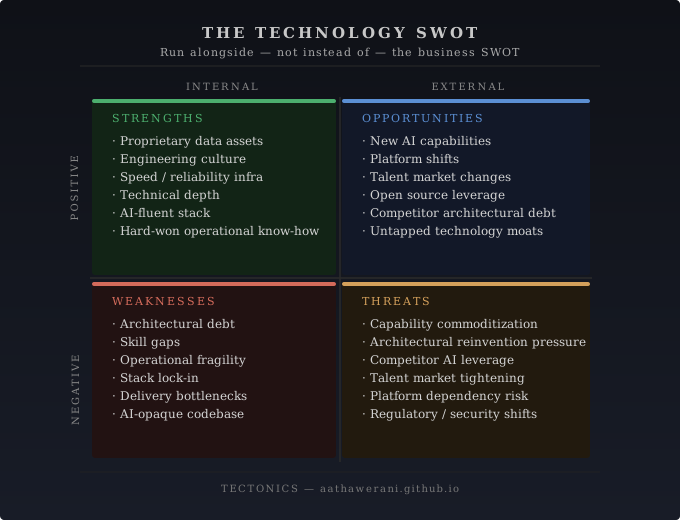
The practical tool at this layer is a technology SWOT — distinct from and complementary to the business SWOT the executive team runs. The business SWOT analyzes market position, commercial strengths and weaknesses, competitive threats, and external opportunities. The technology SWOT runs the same analysis from the technology perspective and surfaces things the business view cannot see.
Technology strengths are the capabilities the organization has built that competitors would find hard to replicate: proprietary data assets, engineering culture, technical infrastructure that enables speed or reliability at scale. Technology weaknesses are the accumulated constraints that limit strategic options: architectural debt that makes certain product directions prohibitively expensive, skill gaps that make certain approaches unexecutable, operational fragility that caps the pace of change the organization can absorb. Technology opportunities are the external developments — new tools, new platforms, shifts in the talent market, emerging AI capabilities — that the organization is positioned to exploit before competitors do. Technology threats are the forces that could erode current advantages: commoditization of capabilities that were once differentiators, platform shifts that require architectural reinvention, AI tools that allow smaller competitors to close the capability gap faster than anticipated.
The business and technology SWOTs should be run together and compared explicitly. Where they diverge is where the most important layer-one conversations happen: a business opportunity that the technology SWOT reveals as unexecutable, a technology strength that the business has not yet found a way to monetize, a technology threat that the business has not yet registered as a strategic risk.
Strategic decisions are defined by their irreversibility, not their importance. A decision that cannot be undone in under six months is a strategic decision, regardless of how it was framed when it was made.
The questions that belong at this layer: what is the defensible technical moat, if any? Where does software differentiation matter and where is it commodity? What engineering capabilities need to exist in-house, and which can be bought, rented, or partnered for? Are there capabilities where coopetition produces more value than independent investment? What does the talent market allow us to credibly build?
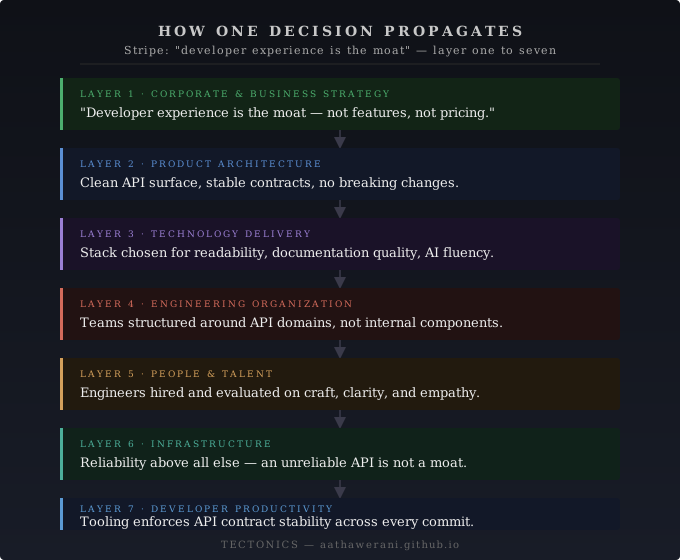
The clearest illustration of a layer-one decision made correctly is Stripe’s early bet that developer experience was the moat. Not features, not pricing, not distribution — the quality of the API and the quality of the documentation. That was not an engineering decision. It was a corporate strategy decision about what the company would be. It shaped everything below it: the product architecture had to be clean enough that the API surface was genuinely pleasant to use, the engineering organization had to value craft in ways that could sustain a developer-first culture, and infrastructure had to prioritize reliability because an unreliable payment API is not a moat. A single strategic call at layer one propagated through every layer beneath it for years.
Layer 2: Product Architecture
Time horizon: Months to years. Reversibility: Low.
The second layer is where technical strategy becomes technical structure — where the business’s intent to build a specific kind of product is translated into the architectural decisions that will shape how that product can evolve.
This is the layer most CTOs feel most at home in. It is the layer of system design: how is the product decomposed, how do its components communicate, where are the boundaries drawn, what are the contracts between services, how is data modeled and owned, what are the consistency and availability properties the system needs to have. The primary criteria here are scalability, security, resilience, and the system’s capacity to absorb change without structural collapse.
But framing it as pure technical design misses what makes it hard.
Product architecture decisions are not evaluated against technical correctness. They are evaluated against a product roadmap that does not yet fully exist. The architect is making bets about which capabilities the product will need, in what order, at what scale. A decision that is correct for the product as it exists today may be deeply wrong for the product as it will need to exist in eighteen months. A system designed for a single-tenant model will not cleanly become multi-tenant. A system built around a monolithic data model will not cleanly decompose. A system optimized for read-heavy access patterns will not gracefully absorb write-heavy load.
The job of product architecture is not to design for today’s requirements. It is to design for tomorrow’s changes.
The failure mode at this layer is premature optimization in either direction. Too rigid, and the architecture cannot absorb the product evolution that is inevitable. Too loose — “we’ll figure it out when we get there” — and the product accumulates structural debt that makes each evolution more expensive than the last until some transitions become effectively impossible.
The questions that belong here: where are the natural seams in the product domain, and are the architectural boundaries aligned with them? Which parts of the system need to evolve independently, and are they actually independent? What are the data models that are most expensive to migrate, and are they designed to survive product changes? What are the external interfaces — to customers, to partners, to regulators — and are they stable even when internals change?
Netflix’s migration from a monolith to services is the canonical example of a layer-two decision made correctly — but only in retrospect. The decomposition was not driven by technical elegance. It was driven by a product requirement: different parts of the system needed to scale independently because different parts of the product experienced radically different load profiles. The recommendation engine, the streaming pipeline, and the user account service had nothing in common in terms of their scaling needs. The architecture had to reflect that, or the product could not evolve to meet it. The organizational restructuring that followed — separate teams, separate ownership, separate deployment pipelines — was not a consequence of the architecture. It was required by it.
Layer 3: Technology Delivery
Time horizon: Months to years. Reversibility: Low to medium.
The third layer is the one that separates the architect’s perspective from the CTO’s. An architect evaluating a proposed system design asks: is this scalable, is it secure, is it the right structure for the product we are building? These are the right questions for layer two. But the CTO has to put on a different cap and ask a different set of questions about the same decision: can we actually deliver this, on what timeline, with what team? And once it is in production — can we support it, debug it, explain it to a customer when something goes wrong?
These are not architectural questions. They are operational ones. And they belong at their own layer because they are evaluated against entirely different criteria, and because getting them wrong produces entirely different consequences from getting layer two wrong.
The technology stack decision lives here more than it lives at layer two. A CTO choosing between technology options is not primarily making an architectural choice — the architecture can often be expressed in multiple stacks equally well. They are making an operational and delivery choice: which stack allows the team to move at the speed the business requires? Which stack is supportable with the team that exists, and the talent that can be hired? Which stack is legible enough to an AI agent that the team can leverage AI assistance across the full delivery cycle — from initial development through to production support?
This last criterion is newer but increasingly decisive. A stack with deep AI tooling support — where the language, the ecosystem, and the common patterns are well-represented in AI training data — compresses delivery timelines in ways that a technically superior but AI-opaque stack cannot match. The choice of Python over Java for a given system may be architecturally neutral. Operationally, in a world where AI agents are doing a meaningful fraction of the implementation and support work, it is not neutral at all.
The CTO who evaluates a technology choice purely on architectural merit is answering the right question at the wrong layer.
The questions that belong here: how long will it take to deliver the first version, and the tenth version, with this stack and this team? When something breaks in production at 2am, how quickly can the on-call engineer understand what went wrong and why? Can an AI agent navigate this codebase reliably enough to assist with debugging, with code review, with generating test coverage? What is the support burden this technology choice places on the team — and is that burden sustainable at the scale the product needs to reach?
The failure mode at this layer is invisible to architects and visible to everyone else. An architecture that is technically correct but operationally brutal produces delivery timelines that look like team performance problems, support burdens that look like reliability problems, and attrition that looks like culture problems. None of these are the root cause. The root cause is a layer-three decision that was never made explicitly — because it was evaluated at layer two, against layer-two criteria, by people whose job is layer two.
Layer 4: Engineering Organization
Time horizon: Quarters to years. Reversibility: Medium.
The fourth layer is organizational: how is the engineering team structured, how is ownership assigned, how do teams coordinate, how are decisions made, how does the organization scale.
This layer is where the stack’s interactions become most consequential — because the engineering organization is the mechanism through which all other layers are realized. The best architecture is worthless if the organization cannot build it. The most operationally sound technology choice is worthless if the team structure creates coordination overhead that cancels out its delivery advantages. The most thoughtful infrastructure is worthless if the teams responsible for it do not have the context to operate it.
Conway’s Law is not an observation about technology. It is an observation about this layer.
Any organization that designs a system will produce a design whose structure is a copy of the organization’s communication structure.
This is not a historical curiosity. It is an active constraint on every architecture decision made at layer two. Teams build what they can communicate about. Boundaries emerge where communication is expensive. The architecture of the product reflects the topology of the organization that built it — and if those two things are not deliberately aligned, they will be accidentally misaligned in ways that compound over time.
The implication is directional: the engineering organization needs to be structured around the product architecture, not the other way around. This is harder than it sounds. Most organizations have existing team structures, existing reporting lines, existing ownership patterns. Changing them is slow and politically costly. The temptation is to fit the architecture to the org rather than the org to the architecture — and this temptation, consistently indulged, is how products become unmaintainable.
The failure mode at this layer is not structural incorrectness. It is structural lag — the organization that was correct for the product at one stage and has not been deliberately redesigned for the next stage. Teams that made sense when the product was a monolith but create friction now that it is decomposed. Ownership models that worked when the team was twenty people but break at a hundred. Coordination patterns that were fine for one product surface but add unbearable overhead now that there are three.
The questions that belong here: does team structure match the system’s architecture — or is it creating architectural pressure the system cannot absorb? Where are the coordination bottlenecks — and are they in the team structure, the ownership model, or the architecture? Is ownership of each component clear enough that the people responsible for it have the context to make good decisions about it?
Amazon’s two-pizza team rule is the most cited example of a layer-four decision — and one of the most misunderstood. The rule was not primarily about team size. It was about ownership. A team small enough to be fed by two pizzas is a team small enough to fully own a component: to understand its behavior under load, to be on call for it, to make architectural decisions about it without requiring coordination with another team. The size constraint was a proxy for the ownership constraint. Organizations that adopted the rule without adopting the ownership model got small teams with diffuse responsibility — which is worse than large teams with clear ownership, because the diffusion is harder to see.
Layer 5: People & Talent
Time horizon: Quarters to years. Reversibility: Medium.
The fifth layer is people: who is on the team, what capabilities they have, how they are developed, and — increasingly — how the boundary between human engineers and AI agents is governed.
This layer is distinct from the engineering organization layer above it. Layer four is about structure — how teams are arranged, how ownership is assigned, how coordination happens. Layer five is about the humans and agents within that structure — their skills, their composition, their development, and the governance model that determines how human judgment and AI capability are combined.
For most of the history of software engineering, the people layer was primarily a hiring and retention problem: recruit engineers with the right skills, keep them engaged, develop them over time. These concerns remain real. But the arrival of capable AI agents has added a dimension that most organizations have not yet explicitly addressed: the engineering team is no longer purely human, and the decisions about how to compose, govern, and quality-control a hybrid team are not being made at this layer — they are being made ad hoc, at layer seven, by individual engineers choosing which tasks to delegate to an agent and which to handle themselves.
That is the wrong layer for those decisions.
The questions that belong at layer five: what is the right composition of human engineers and AI agents for the work this organization needs to do? Which categories of work should remain primarily human — because they require judgment, accountability, or contextual understanding that agents cannot reliably provide — and which can be reliably delegated? What does quality control look like when a significant fraction of the codebase is agent-generated? How is accountability assigned for agent output — who owns it, who reviews it, who is responsible when it fails?
Governance of the human-agent boundary is the defining people challenge of this moment in software engineering. Organizations that have not made explicit decisions at this layer are making implicit ones — usually in the direction of maximum agent adoption at minimum governance, which produces speed in the short term and fragility in the medium term. Code that nobody fully understands, test coverage that was generated rather than reasoned about, architectural decisions embedded in agent output that no human reviewed as architectural decisions.
The question is not whether to use AI agents. It is who is responsible for what they produce — and whether that responsibility is explicit enough to be exercised.
The questions that belong here also include the development of human engineers in an AI-augmented environment. The skills that are most valuable are shifting: from implementation fluency toward specification precision, from code authorship toward architectural judgment, from debugging skill toward the ability to evaluate agent output critically. An organization that is not deliberately developing these capabilities in its human engineers is building a team that is increasingly dependent on agents it does not fully understand and cannot fully supervise.
Layer 6: Infrastructure
Time horizon: Months. Reversibility: Medium to high.
The sixth layer is infrastructure: cloud platform, data platform, networking, security posture, deployment model, observability stack.
This is the layer that generates the most tactical urgency. Infrastructure decisions carry immediate cost implications, immediate reliability implications, and immediate operational overhead. They are also, among the seven layers, among the most frequently conflated with strategic decisions — because the vendors selling infrastructure services have a strong incentive to frame them that way.
They are not strategic decisions. They are structural ones.
Infrastructure is not a strategy. It is the physical expression of an architecture. The choice of database engine is not a business bet. The choice of whether to own your data layer is.
The correct frame for infrastructure decisions is: does this choice give the architecture what it needs to deliver the product the business requires, at a cost structure the business can sustain, with an operational burden the organization can carry?
Notice what is not in that frame: vendor preference, engineer familiarity, and what competitors are using. These are inputs, not criteria. An infrastructure choice that satisfies the frame is a good one even if it is boring. An infrastructure choice that fails the frame is a bad one even if it is technically elegant.
The specific failure that is most expensive is infrastructure lock-in masquerading as a platform bet. Choosing a cloud provider is a reversible decision — painful and expensive to reverse, but possible. Choosing a cloud provider and then building every product capability directly on top of provider-specific services, without abstraction, makes the decision effectively irreversible. This is sometimes the right tradeoff. It is almost never made explicitly.
Dropbox’s decision to migrate off AWS and build its own storage infrastructure — Magic Pocket — is one of the few examples of a layer-six decision made with full layer-one and layer-two visibility. At Dropbox’s scale, storage was the primary cost driver of the business, and the cost curve of managed cloud storage made the unit economics increasingly difficult. The infrastructure decision was downstream of a business strategy question: can this company survive long-term on managed storage costs, or does it need to own the infrastructure to own the margin? Reaching that answer required the CTO to connect infrastructure economics to business strategy — not to evaluate the migration as a purely technical question.
Layer 7: Developer Productivity
Time horizon: Weeks to months. Reversibility: High.
The seventh layer is developer productivity: the tooling, processes, practices, and environment in which engineers work day to day. Build systems, local development environments, CI/CD pipelines, code review processes, deployment tooling, testing infrastructure, documentation practices.
This is the layer that is most frequently mismanaged in two opposite directions.
The first direction is neglect. Engineering leadership treats developer productivity as a maintenance concern rather than a strategic investment, defers improvements indefinitely under delivery pressure, and ends up with a development environment that is slow, fragile, and frustrating — which produces exactly the delivery pressure that supposedly justified not investing in it.
The second direction is over-investment. Engineering leadership treats developer productivity as the primary lever for organizational performance, invests heavily in tooling sophistication and process refinement, and ends up with a beautifully instrumented development environment that is building the wrong product efficiently.
Neither direction understands what this layer is actually for.
Developer productivity tooling is not about making engineers faster. It is about making the architecture legible to the people building it.
A well-instrumented CI pipeline that surfaces architectural violations is valuable not because it speeds up deployment but because it enforces the architectural contracts that the product’s integrity depends on. A local development environment that accurately mirrors production is valuable not because it improves individual productivity but because it reduces the gap between where decisions are made and where their consequences are visible. A test suite with genuine boundary coverage is valuable not because it speeds up delivery but because it is the mechanism by which architectural changes can be validated as safe.
Google’s internal developer tooling — Blaze, Critique, Piper — is the most extreme version of layer-seven investment in the industry, and it illustrates both the ceiling and the precondition. Google spent years and significant engineering resources building tools tightly coupled to its monorepo architecture. The productivity investment was real. But it only paid off because it was designed specifically around Google’s architectural choices. Teams that cargo-culted the tools without the architecture got the complexity without the benefit. The lesson is not that developer tooling investment is always worth it. It is that tooling investment is only worth it when it is directly expressive of the architecture it serves.
How the Layers Break Down
The stack is a decision-making framework, not a delegation model. All seven layers require the CTO’s attention. The question is not which layers the CTO works in — it is whether the decisions being made in each layer are being evaluated against the right criteria.
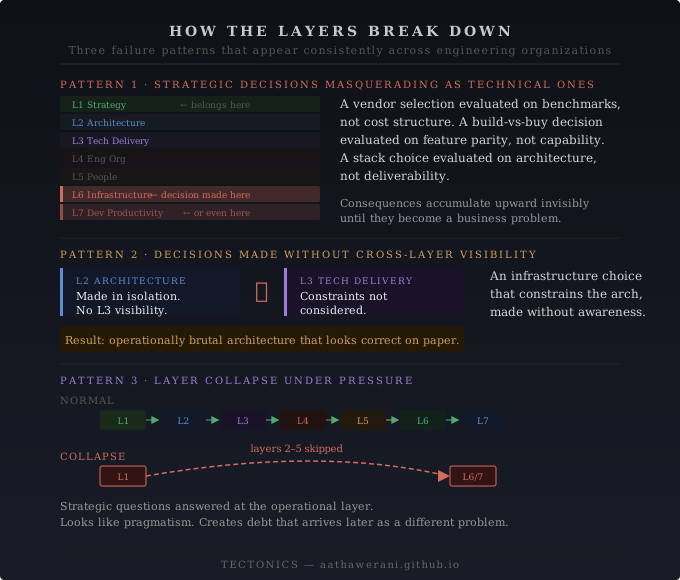
Three breakdown patterns appear consistently across engineering organizations.
Strategic decisions masquerading as technical ones. A platform migration evaluated purely on technical merit. A build-vs-buy decision evaluated on feature parity rather than organizational capability. A vendor selection evaluated on performance benchmarks rather than cost structure at scale. A technology stack choice evaluated on architectural elegance rather than operational deliverability and support burden. In each case, a decision that belongs at layer one, two, or three is being made with layer six or seven criteria — and the consequences accumulate upward invisibly until they become a business problem rather than a technical one.
Technical decisions resolved at the wrong layer. An infrastructure choice that constrains the product architecture, made without awareness of the constraint. An organizational structure that calcifies around a system design that has since changed. A developer productivity investment that optimizes for the current team structure rather than the target architecture. An AI adoption decision made at the tooling layer without reference to the governance model it requires at the people layer. In each case, a decision at one layer is made without visibility into its implications for adjacent layers.
Layer collapse under pressure. When organizations are under delivery pressure, the stack compresses. Strategic and architectural decisions get deferred in favor of operational ones. Technology choices get made by whoever is closest to the implementation, evaluated against implementation criteria. The organizational structure remains frozen while the architecture evolves around it. The people layer never gets explicitly designed — it accumulates by default. The collapse is not visible as a failure at the time — it looks like pragmatism, like keeping things moving. The debt it creates becomes visible later, when the organization discovers that it cannot make a particular architectural change because the organizational structure is in the way, or that it cannot pursue a strategic direction because an infrastructure choice made two years ago has made it prohibitively expensive.
A Note on AI
AI does not belong to a single layer of the stack.
Most organizations experience it first at layer seven — developer tooling, coding assistants, CI integration. But its consequences reach all the way up: to how teams are governed at layer five, to how technology is selected at layer three, to how architecture is designed at layer two, and ultimately to what kind of company this organization can credibly be at layer one.
Treating AI as a tooling decision is often the first and most visible example of layer collapse. The full implications of AI across each layer of the stack deserve a separate treatment — and that is where this series goes next.
The Stack in Context
The seven layers are constant. What varies is how they behave depending on organizational context — and the variation is large enough to warrant its own treatment.
The short version: the startup’s primary risk at each layer is invisibility — decisions being made without awareness that a layer exists. The enterprise’s primary risk is disconnection — layers operating without awareness of each other.
Both risks produce the same outcome: decisions made at the wrong layer, evaluated against the wrong criteria, with consequences that arrive later and look like a different problem than the one that caused them. How each context produces that outcome, and what to do about it, is where this series goes after AI.
Using the Stack
The decision stack is not a process. It does not tell you what to decide. It tells you where a decision belongs — which changes how it is evaluated, who should be in the room, and what counts as a good outcome.
The diagnostic is simple. For any significant decision the engineering organization is facing, ask: what layer does this decision actually live in? Then ask: is it being evaluated at that layer?
If a technology stack choice is being evaluated on architectural elegance rather than delivery speed, support burden, and AI fluency, it is being evaluated at the wrong layer — layer two criteria applied to a layer three decision. If a decision about organizational structure is being made without reference to the architectural boundaries the organization needs to maintain, it is being made at the wrong layer. If a decision about cloud vendor is being made as a strategic bet when it should be evaluated as an infrastructure tradeoff, it is being framed at the wrong layer. If decisions about AI agent governance are being made by individual engineers at the tooling layer rather than explicitly at the people layer, they are being resolved three layers below where they belong.
Most of the time, the problem is not the decision. It is the frame.
The CTO’s job is not to make decisions. It is to make sure decisions are made at the layer they actually belong to — with the right information, the right people, and the right criteria.
The stack also provides a map for communication. Different stakeholders in an organization have visibility into different layers. Engineers have the deepest visibility into layers six and seven. Product managers have the clearest view of layer two’s requirements. HR owns parts of layer five without owning the layer. The executive team lives in layer one. The CTO is the only person in the organization whose job requires fluency across all seven levels — and whose value comes precisely from the ability to translate between them: to carry the implications of a strategic decision downward into infrastructure choices, and to surface the implications of an operational constraint upward into product and business conversations.
Most technology failures are not failures of architecture, infrastructure, tooling, or people. They are failures of framing.
Decisions made at the wrong layer eventually create consequences that appear somewhere else — and look like a different problem than the one that caused them.
The CTO Decision Stack exists to make those layers visible before the consequences arrive.
Ali Ahmed Thawerani writes about the systems, culture, and scale decisions that shape how technology organisations develop. TECTONICS publishes at aathawerani.github.io.